Tribal Casinos: The Latest Front In America’s Culture Wars
Arguments against DEI are now being employed to threaten Indian gaming

9 min

More than 37 years after Ronald Reagan signed the Indian Gaming Regulatory Act (IGRA), some in tribal gaming say commercial operators now appear to be taking a cue from Donald Trump and attacking the legal foundation for tribal gaming.
In January, Churchill Downs Inc. joined a growing chorus of commercial gaming interests who argue that traditional elements of tribal gaming constitute “a race-based monopoly” that violates fundamental equal protection rights. The company, which owns the famed Louisville racetrack that hosts the Kentucky Derby as well as a dozen brick-and-mortar casinos, filed a lawsuit challenging legislation that granted four tribes exclusive rights to operate online casino platforms in Maine.
Like IGRA, the Maine legislation sought to elevate economically disadvantaged tribes through gaming. But Churchill Downs dismisses the plan as institutionalized discrimination akin to diversity, equity, and inclusion (DEI) — one of Trump’s favorite culture war targets.
“If the Maine Legislature has made the choice to allow iGaming within the State,” Churchill Downs wrote in its complaint, “it should give everyone a fair chance to compete, without regard to race or citizenship, as both the United States and Maine Constitutions require.”
The racetrack owner’s lawsuit not only echoes recent legal arguments put forth by other commercial gaming operators, but also critical analyses of Project 2025, the conservative Heritage Foundation’s blueprint for a second Trump administration that is increasingly viewed as prescient.
Some in tribal gaming consider efforts like the Maine iGaming legislation to be just as threatening as prediction markets, imperiling not only tribal gaming but everything tribes have built for themselves and their people.
“You could view these as objectively weak legal arguments without a lot of chance of carrying the day,” said Kathryn Rand, a visiting professor at the University of Nevada, Las Vegas and a leading expert on Indian gaming. Or, she said, you could say “these are existential threats to tribes’ very existence as governments under federal Indian law.”
But regardless of whether they’re successful, Rand said, “they are capturing the attention of the public and policymakers,” which means tribes have to take them seriously and fight back.
“If that idea of an unconstitutional, race-based gaming monopoly takes hold, and if it takes hold in the media, with the public, with policymakers, if state and federal officials and others start to talk about that,” said Steve Light, another visiting professor at UNLV and Indian gaming expert, “that’s the snowball effect that in the long term could be extremely damaging to tribes’ sovereign status.”
Similar arguments in other cases
The Churchill Downs case is the latest in a series of gaming lawsuits that appear to use what critics call Trump-era culture war logic to return tribes to their status before 1968, when tribal sovereignty was treated more like a policy preference than a binding legal commitment.
In 2021, the operator of a commercial casino in Miami sued the U.S. Secretary of Interior for approving an online sports gaming compact between the Seminole Tribe of Florida and the Sunshine State, arguing that agreement gave the tribe “a monopoly … on the basis of the race of the Tribe’s members.”
A year later, Maverick Gaming, the owner and operator of cardrooms in Washington state, sought to overturn a law giving federally recognized tribes the exclusive right to offer sports betting in the Evergreen State.
“The tribal monopoly … violates the Constitution’s guarantee of equal protection of the laws by irrationally and impermissibly discriminating on the basis of race and ancestry,” Maverick wrote in its complaint.
Final rulings in both cases did nothing to change the status quo, with neither court addressing their equal protection claims. But it only takes one judge to give these arguments momentum and pave the way for a majority-conservative U.S. Supreme Court to chip away at tribal sovereignty or even dramatically change tribal relations with federal and/or state governments.
And it’s not like this line of thinking is coming from some fringe group. Some say it’s supported in a document that many believe is guiding the Trump presidency.
A conservative blueprint
At least 140 people who worked in the first Trump administration reportedly played a role in drafting Project 2025, a sweeping policy plan published by the Heritage Foundation during the run-up to the 2024 presidential election. Conservative activist William Perry Pendley, the director of the U.S. Bureau of Land Management during Trump’s first term, authored the section on the Department of Interior, which includes a discussion of tribal affairs.
Some interpret Pendley’s section as calling for a dramatic rethinking of our notions of tribal sovereignty, transforming it from a permanent status established by treaties and the Constitution into something far more provisional, a privilege or preference that can be given and revoked by those in power. Some readers say it also advocates for unilateral decision making by the federal government on matters in which tribal input was once required as well for a lot more drilling and mining on tribal lands to restore what Pendley called “American energy dominance.”
“Pendley’s selection itself raised red flags given his problematic history of extremism,” wrote the Global Project Against Hate and Extremism, a nonprofit dedicated to stopping far-right extremism. “For three decades before joining the Trump administration in 2019, he headed the Mountain States Legal Foundation, an organization heavily funded by fossil fuel companies. There, he mocked Native American land management practices and dismissed the Black Lives Matter movement as based on a ‘lie.’ Pendley openly shared racist views on blood quantum, a legal term used to quantify Native American ancestry and determine tribal enrollment, while warning about what he termed ‘an increasingly important issue in the West, that is, the willingness of federal land managers to close public land because it is sacred to American Indians.’”
Trump distanced himself from Project 2025 during the election, but then embraced its ideas as president. In fact, the president’s policies have so closely aligned with Project 2025 suggestions that in January author Parker Molloy wrote that it was “media malpractice” for anyone in the press not to know what exactly was coming from a second Trump term.
“Anyone who wanted to know what Trump’s allies were planning could simply read it,” she said of Project 2025.
But even without the Heritage Foundation’s 920-page treatise, some Native Americans say they have been skeptical of the president’s intentions due to his combative relationship with tribal gaming before he ran for president. In 1993, Trump famously testified before a House subcommittee that the operators of a tribal casino “don’t look like Indians to me,” a statement many viewed as nakedly racist.
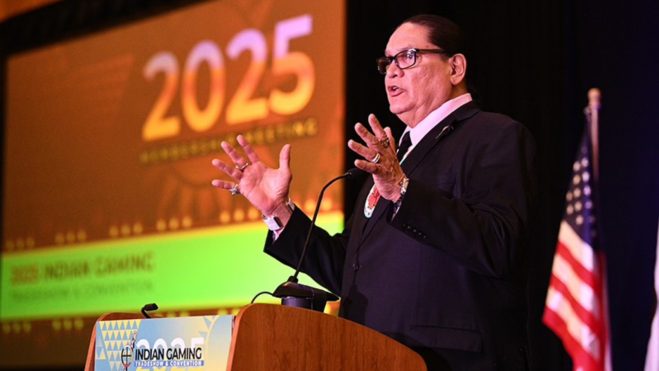
With respect to gaming, “it is concerning that Project 2025 and this administration are taking the positions that they are,” said David Bean, chairman of the Indian Gaming Association. “They’ve taken these positions without actually having sat down with large tribal organizations.”
Bean said arguments seeking to recast the political status of tribes and tribal members as a race-based preference are an afront to hundreds of years of treaties and agreements, but tribes are prepared to defend themselves as any sovereign nation would, through diplomacy. But diplomacy, he noted, only works when both sides are prepared to engage in constructive, good-faith negotiations.
“It should come from a place of healthy respect,” he said, “and we’re simply not seeing that.”
A return to the Termination Era?
The federal government’s relationship with tribes has been rocky since the beginning.
In the nation’s early days, America recognized tribal sovereignty, but also frequently violated land treaties. Then, from the late 1880s through the early 1930s, it broke up tribal lands to encourage Native Americans to assimilate into white society.
Passage of the Indian Reorganization Act of 1934 didn’t end efforts at assimilation, but did create an environment that helped tribal governments organize. That lasted about 20 years. Then, in 1953, Congress passed House Concurrent Resolution 108, which sought to end tribes and subject Native Americans to the same laws as other U.S. citizens.
So began the Termination Era, a turbulent period in U.S.-tribal relations, when several established tribes ceased to exist.
Historians typically say this period lasted about 15 years until Congress approved the Indian Civil Rights Act of 1968. But arguably the modern U.S. policy of fostering self-determination and self-governance for Native Americans wasn’t locked in until Reagan signed Executive Order 12401 in 1983, establishing the Presidential Commission on Indian Reservation Economies.
Today, it’s U.S. policy to treat tribes the same as foreign governments. But the litigants in the Churchill Downs and related cases seem to be suggesting that is a mistake. The specifics of their position are unclear, however.
An attorney involved in both the Churchill Downs and Maverick cases ultimately declined to speak with Casino Reports after considering it for several days. Also declining was Churchill Downs itself, while representatives of Maverick Gaming and West Flagler Associates, the lead litigant in the Florida case, failed to respond to Casino Reports’ requests for comment.
Penn Gaming CEO Jay Snowden has weighed in on the matter, though. During a late February earnings call he said the Maine legislation at the heart of the Churchill Downs case was profoundly unfair.
“What happened in Maine is mind-blowing,” Snowden said. “We’ve been operating there for two decades, we’ve employed hundreds of Mainers, we’ve invested in the state. And the governor has decided to hand a monopoly to a third party that has never invested a dollar in the state. That’s being challenged legally. But it is what it is, and we’ll find a way to compete if it does stand up legally.”
Some in tribal gaming find that perspective offensive.
“Referring to state/tribal compacts as ‘race-based preferences’ or ‘monopolies’ does an injustice to state and tribal governments and shows a profound ignorance of our nation’s history,” said gaming consultant Gene Johnson in an email to Casino Reports.
Johnson is the executive vice president of Victor Strategies, a gaming consulting firm headed by the prominent tribal leader Victor Rocha.
“The Maine iGaming decision is not a racial preference, it is a political agreement between sovereign entities concerning mutual economic development,” Johnson said. “America rejected termination policy along with segregation back in the civil rights era, and Indian nations will not be reduced to just another racial designation.”
Forced assimilation
The implications are far reaching for a world where the special political status of tribes and tribal members could be reduced to just another racial preference. It could not only impact tribal gaming, but also some of the most sensitive and traumatic issues for Native Americans.
Consider the case of Chad and Jennifer Brackeen, a white, evangelical couple from Fort Worth, Texas who wanted to adopt a two-year-old boy of Navajo and Cherokee descent they had been fostering. In 2017, a judge ruled that the boy should be sent to New Mexico to live with a Navajo family as required by the Indian Child Welfare Act (ICWA), a 1978 law that prioritizes Native American children being raised by people from their own tribes.
ICWA was passed in response to decades of forced assimilation in which the federal government made Native American children leave their homes to attend boarding schools where they were indoctrinated into a white worldview.
The Brackeens filed a lawsuit arguing that ICWA violated equal protection rights, a challenge similar to the ones put forth later by commercial gaming operators in Florida, Maine, and Washington state.
The case wound its way to the U.S. Supreme Court, where 497 tribal nations submitted briefs in favor of upholding ICWA. In 2023, the conservative majority court upheld the law on a 7-2 vote.
“Our Constitution reserves for the Tribes a place — an enduring place — in the structure of American life,” Justice Neil Gorsuch wrote in a concurring opinion. “It promises them sovereignty for as long as they wish to keep it.”
Furthering ‘Indian self-government’
Decades earlier, the Supreme Court also upheld existing law in a similar case from the 1970s that challenged the Bureau of Indian Affairs’ (BIA) preference for hiring Native Americans. That case was brought by non-Indian employees of the bureau who argued that its hiring preferences were discriminatory.
The court, however, found that the “preference does not constitute invidious racial discrimination in violation of the Due Process Clause of the Fifth Amendment but is reasonable and rationally designed to further Indian self-government.”
“Congress was well aware that the proposed preference would result in employment disadvantages within the BIA for non-Indians,” wrote former Justice Harry Blackmun in the unanimous opinion of the court. “Not only was this displacement unavoidable if room were to be made for Indians, but it was explicitly determined that gradual replacement of non-Indians with Indians within the Bureau was a desirable feature of the entire program for self-government.”
This case, known as Morton v. Mancari, acts as a lynchpin of tribal sovereignty in the United States. It establishes that the relationship between tribes and the U.S. is a government-to-government relationship, not a race-based one. It’s also what some in tribal gaming fear to be the ultimate target of litigants in the Churchill Downs and related cases. Tribes worry this could be used to roll back economic gains they’ve achieved through gaming.
In the Brackeen adoption case, Supreme Court Justice Brett Kavanaugh authored a two-paragraph concurring opinion in which he said the lawsuit raised “significant questions under bedrock equal protection principles and this Court’s precedents.” He then seemed to invite future litigation in this area by adding, “Courts, including ultimately this Court, will be able to address the equal protection issue when it is properly raised by a plaintiff with standing.”
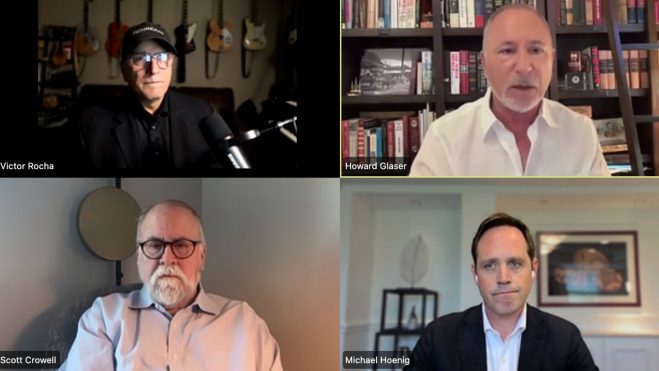
Tribal attorney Scott Crowell said the Churchill Downs litigation is just the latest attempt to serve up a lawsuit that the Supreme Court could use to overturn the Morton precedent.
“If you don’t have that legal foundation, you really throw into jeopardy all the success that the tribes have had in becoming viable, strong governments,” Crowell said. “Stewarding their lands, caring for their people is at risk. I wish I could not be so dramatic in terms of what I think the consequences would be. But anybody that thinks you would have anything close to the current status quo if Morton v. Mancari were overruled is kidding themselves.”