Pivot Or Panic? Assessing Fliff’s Float From Sweeps To DFS
Move from vertical outlawed in California to one on shaky ground there raises eyebrows

4 min
The saying “when one door closes, another opens” suggests a passive approach to bouncing back from disappointment. For gaming operator Fliff, a change enacted at the start of 2026 reveals a more active posture — in essence, “When one door closes, force another one open.”
Fliff launched as a social/sweepstakes sports betting app back in 2019, and steadily attracted a large user base and then piles of criticism as it became a popular way for those in the 18-20 demographic to wager on sports and both deposit and withdraw real money through the dual-currency model that defines sweepstakes gaming apps (or “social plus,” as they are now called).
But when California — the largest market in the nation by far — passed legislation banning the dual-currency model for gambling last fall, operators were forced to make difficult decisions. Some shut down entirely, some expanded into other states to make up for losing California, some attempted to weave their way through a new loophole by adding a third currency of sorts.
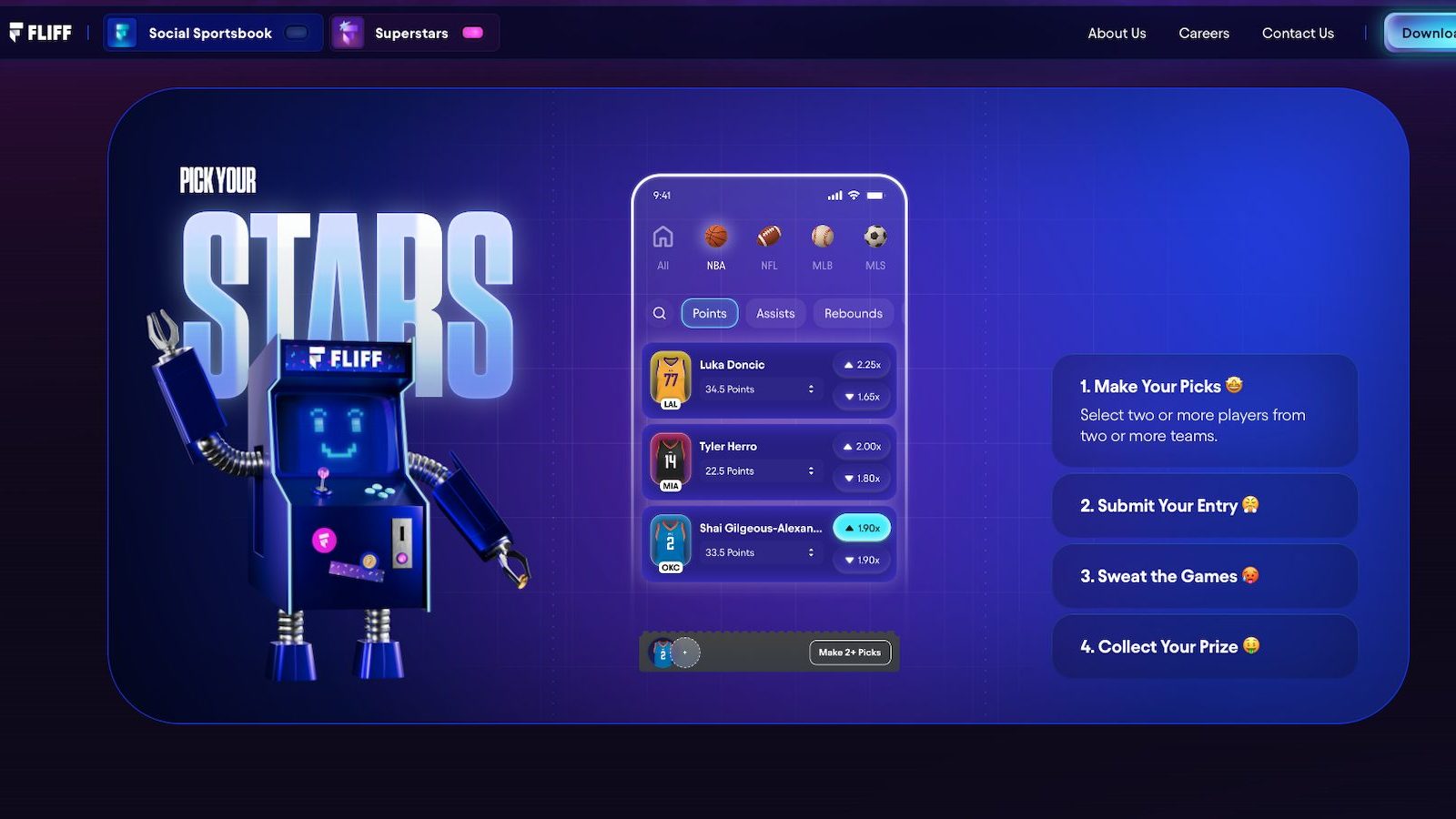
Fliff took its own tack, introducing a new game called Superstars that isn’t traditional sports betting and doesn’t use the sweepstakes model. Rather, Superstars follows the DFS+ lead of companies like Underdog and PrizePicks, packaging itself as peer-to-peer fantasy.
And that’s a particularly intriguing choice since real-money fantasy is also under attack in California, even if it hasn’t been outright banned in the way sweeps has.
That’s just, like, your opinion, man
Last July, California Attorney General Rob Bonta issued an opinion that real-money online fantasy sports platforms are illegal in the state, based on his interpretation of existing law.
It was only an opinion, and Gov. Gavin Newsom was quick to publicly dissent from it, but it at least had a chilling effect on against-the-house DFS+ games, with the likes of PrizePicks and Underdog switching exclusively to offering peer-to-peer DFS contests, which has been the approach of DraftKings and FanDuel in the state.
Last July 3, the Fantasy Sports & Gaming Association (FSGA) released a statement on Bonta’s opinion that began:
“Today’s opinion by California Attorney General Rob Bonta that Daily Fantasy Sports are illegal isn’t grounded in common sense and is completely out of step with opinions rendered in other jurisdictions across the U.S.
“The Fantasy Sports & Gaming Association (FSGA) maintains that paid fantasy sports contests are legal games of skill under California law, and this view is supported by 26 states that have confirmed fantasy sports are legal games of skill and not gambling. In these instances — whether by legislation, AG opinions (West Virginia, Rhode Island), or state supreme court decisions (New York, Illinois) — the legality is clear.”
Some six months later, former FSGA Chairman Peter Schoenke, now the organization’s head of government affairs and all along the president of RotoWire, sees a fantasy landscape where operators are cautiously continuing with their products while in wait-and-see mode about any sort of legislation or enforcement in California.
“Just because the state comes out with an opinion, that doesn’t mean that there’s going to be action,” Schoenke told Casino Reports. “Of course, it is just an opinion. It’s not the law of the land, and there can be court cases and challenges. The industry has done that before when they challenged it in New York, among other places.”
Schoenke specifically cited Texas and Florida as notable examples. Texas Attorney General Ken Paxton issued a 2016 opinion that paid DFS is illegal in the Lone Star State, while Florida has a similar AG opinion dating all the way back to 1991 (long before DFS was a thing).
“With Texas and Florida,” Schoenke said, “for a long time, the industry was just kind of waiting for the next shoe to drop, and then it never did.”
‘It’s not going to work’
Fliff is making the calculation that whether or not any enforcement will be coming in California, continued operation in the state is crucial, and worth making some adaptation (Casino Reports attempted without success to reach Fliff CEO Matt Ricci for this article.)
One person who feels that’s a miscalculation is outspoken tribal leader Victor Rocha of Pechanga.net, the conference chair of the Indian Gaming Association, a driving force over the years in limiting organizations’ ability to offer forms of gambling in California without the buy-in of the state’s gaming tribes.
“This is still gambling,” Rocha said. “The attorney general says it’s gambling. I believe it’s gambling. You saw what happened to sweepstakes. Now we’re getting ready for DFS. What they’re doing is illegal — in our opinion it’s illegal, it’s a violation of the tribal compacts, the state constitution which give the tribes exclusivity over gambling in California.
“So they think they’re going to come into the market and that when sports betting comes they’ll be able to jump right in, but it’s not going to work. We will do everything possible, whatever it takes, to make sure they do not succeed in California.”
Rocha admitted the tribes were “caught flat-footed” when sweepstakes first arrived, but now they’re ready for efforts like Fliff pivoting to a form of fantasy sports.
“They’re trying to get in any way they can,” Rocha said. “They’re holding their breath and hoping nobody notices. And, listen, the money is in California, we know it. We intend on cutting that oxygen off for those rat bastards.”
Peer-to-peer pressure
It’s noteworthy that several of these DFS+ operators have gone the peer-to-peer route, indicating they’re less worried about Bonta’s opinion applying to those games. Schoenke, though, doesn’t feel the AG opinion draws any distinction.
“This AG opinion doesn’t really talk specifically about any one kind of fantasy product, it’s pretty much all paid fantasy sports,” Schoenke said. “It’s a pretty blunt opinion. As far as the companies operating in the state, they’re all independent actors with their own views of what they can and should do.”
Since Fliff launched Superstars, some have speculated that the company is entering the DFS+ competition too late in the game to succeed, with the likes of Underdog and PrizePicks having such a sizeable head start. Then again, Fliff may be content with not gaining new customers, as long as it’s giving its former sweepstakes customers a product to use in California (and the 10 other states Superstars is offered) so they stick around.
“It’s hard to handicap,” Schoenke said of Fliff’s chances for success in the competitive California market. “I mean, the one thing about this industry over the last 10 to 15 years is, some company always comes along, and you think there’s no chance that they’re going to be the next big thing, and then sometimes they are.”
For Fliff, the options were retreat or reform, with sweepstakes gaming no longer a viable option in California and assorted other states. Time will tell if the company turned around in a dead end and found an open road ahead, or spun around from that dead end and simply stumbled down a different one.