Einstein Was Wrong About The Universe, I’m Wrong About My Lucky Underwear
A quantum physics lesson for gamblers who talk to slot machines, and a Nobel Prize-winning proof that the universe doesn’t care

5 min
I hate the fact that I’m superstitious. I consider myself a man of science, a man of math, a man of reason.
Yet … someone spills salt in my presence, you better believe they’re going to throw a pinch of it over their left shoulder. I’ve yet to purposefully step on a crack, lest I break my mother’s back. Pick up a coin that’s not on heads? Not once, not ever.
It’s not just the clichés, either. I have a pair of orange Hawaiian-themed boxer shorts that have zero elastic left to them and holes everywhere. If I were to put them on my body, they would be pornographic, and not in a good way, in about two seconds. But they still live in my underwear drawer and every time I fly, I pack them in my carry-on. Why? Because about 25 years ago I flew with them — on my body, for they were new — and for some reason this stuck with me and now I’m not flying without them. I’m like Lois from Goodfellas, except it’s useless underwear instead of a hat.
Now, I know — well, at least I’m reasonably certain — that my underpants are not keeping any plane aloft. I know no amount of spilled salt will end the world, my mother’s back will be fine regardless of where I step (unless I step on her), and any coins I leave lying in the street only affect my personal wealth.
And yet I continue believing, despite my at-worst semi-reasonable intelligence, that things I do (pack holey underwear) have a direct effect on things out there (planes not dropping out of the sky).
This continues in my gambling life. When I’m tilting out at Larry the Lobsterman, if you think I don’t sometimes stop and talk to the damn random number generator, you’re sadly mistaken. When I go to look to see if Tyler Higbee scored a touchdown at +350 on the ESPN app, you better believe I look at the play-by-play instead of the scoring rundown, because obviously — obviously — if I look at the play-by-play, my odds will get better.
I am hopelessly superstitious. Luckily for me, this puts me in good company.
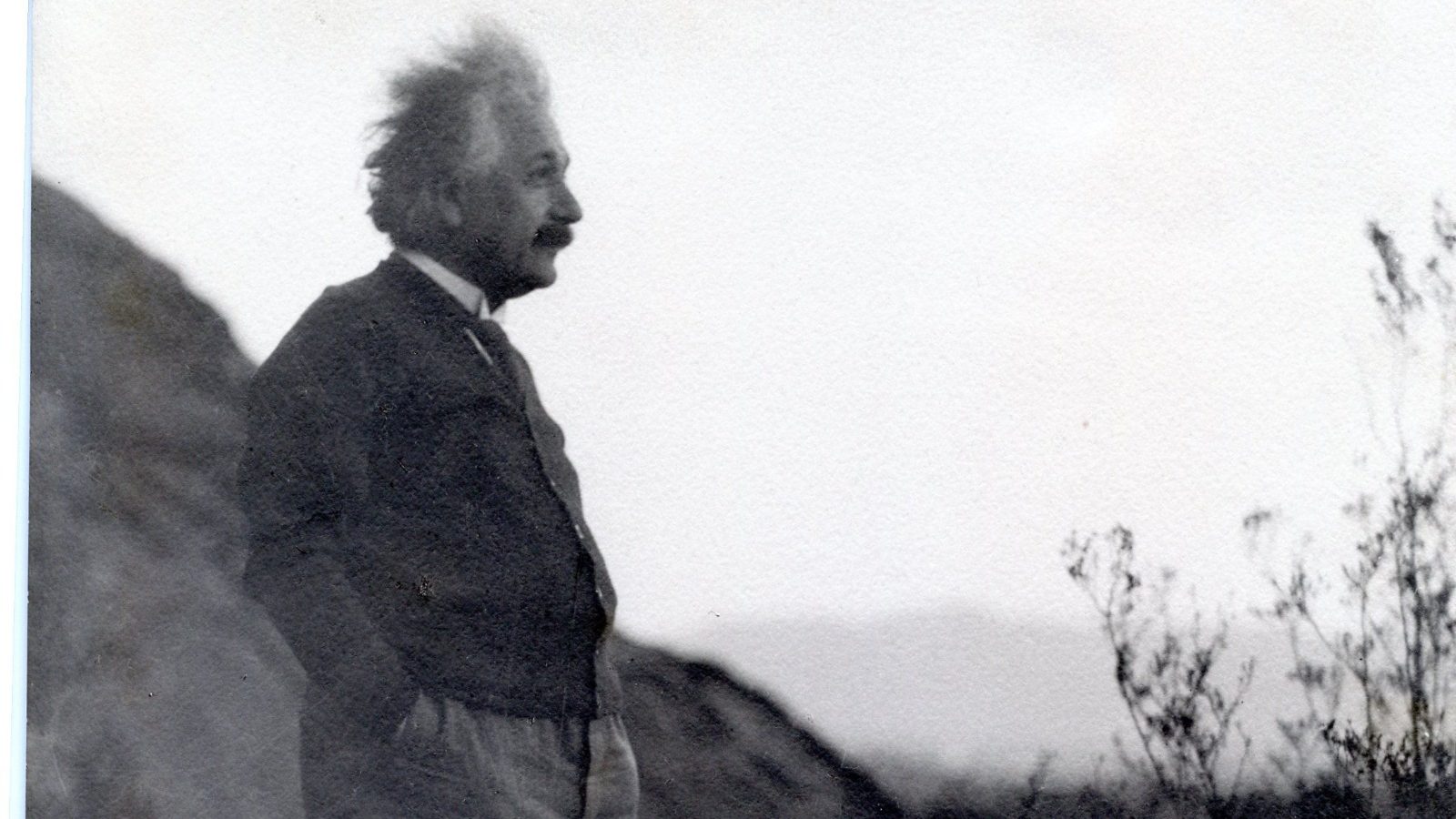
Albert Einstein believed the same thing. And it drove him a little bit crazy.
Funny business at a distance
Einstein famously hated quantum mechanics. Not disliked — hated. Thought it was fundamentally wrong. Offensive, even.
The problem wasn’t that the math didn’t work. The math worked beautifully. The problem was what the math implied.
Quantum mechanics says that at the smallest levels of reality, particles don’t have definite properties until you measure them. Not “we don’t know what they’re doing” — they literally don’t have values until you look. Even worse, particles can become “entangled,” meaning two particles separated by vast distances — like, theoretically, bazillions of light years — can be measured and knowing something about one instantly tells you something about the other. No signal. No delay. Just correlation.
Einstein called this “spooky action at a distance,” and he did not mean it as a compliment.
His objection boiled down to two very reasonable beliefs. First, reality should be real. Things should have properties whether or not we’re watching. A die has a number facing up even when your hand is covering it. Second, no funny business at a distance. Nothing should influence something else faster than light. Cause, then effect. Nice and clean.
If quantum mechanics violated those rules, Einstein figured the theory had to be incomplete. There must be hidden variables, extra information baked into reality that we just hadn’t found yet.
In other words: The universe looks random only because we don’t know enough.
That’s a deeply comforting idea. And a deeply human one. It’s also, essentially, what I believe every time I pack those boxer shorts or check the play-by-play or don’t pick up the coin.
Einstein might have been a genius, but …
Then, in the 1960s, a physicist named John Bell came along and proved it all.
Bell asked a simple question: What if we design an experiment where the universe has to choose? He proved mathematically that if Einstein was right, that if particles had pre-existing properties and nothing spooky was happening, then certain measurements would always fall within hard limits. Mathematical guardrails.
Quantum mechanics predicted those limits would be violated.
So physicists ran the experiments. Again. And again. And again.
The limits were violated. Every time.
Which means at least one of Einstein’s assumptions has to be wrong. Either properties don’t exist until they’re measured or the universe allows correlations that ignore classical cause and effect. Or both.
What cannot be true is the thing Einstein wanted most: a neat universe with hidden order underneath the randomness.
Bell’s Theorem doesn’t say “everything is chaos.” It says something more unsettling: The randomness isn’t hiding anything. What you see, no matter how insane, is what you get.
Ching-a-ling-ding
Now let’s take a walk to the casino. Look around. Look at that guy over there. Lucky shirt. Lucky seat. Blowing on the dice like it matters. Getting annoyed if someone touches the chips the wrong way. Saying things like, “Don’t say seven,” and meaning it.
When he says “the table’s hot” or “this machine is due” or “I’m on a run,” what he’s really saying is: There is extra information in this system that I can sense, even if I can’t measure it.
That’s exactly Einstein’s position. And it has a name in our world: the Gambler’s Fallacy.
The Gambler’s Fallacy is the belief that past random events influence future ones. That the dice have a memory. That the deck knows what it just did. That the roulette wheel is aware it’s been embarrassing you and will eventually feel bad about it.
But Bell tells us that belief is wrong in systems that are genuinely random. Each roll of the dice isn’t just unrelated to the last one; it’s structurally forbidden at the quantum level from carrying hidden information forward. There is no “I’m due.” No momentum. No balancing force quietly working behind the scenes.
The Gambler’s Fallacy is, at its core, a belief in hidden variables. And Bell’s Theorem proved hidden variables don’t exist.
Here’s the uncomfortable part: Einstein wasn’t stupid for believing otherwise. He was human. The idea that the universe could be fundamentally random offended him so deeply that he spent decades trying to prove reality wrong.
He failed.
If Albert Einstein couldn’t accept true randomness, what chance do the rest of us have? What chance do I have, standing at baggage claim, making sure I can feel those ratty boxers in my carry-on before I let myself believe the flight actually went OK?
Lessons learned? Not
Here’s where I’m supposed to tell you I’ve learned my lesson. That understanding Bell’s Theorem has cured me of magical thinking. That the boxers are in the trash and I’m walking on cracks with abandon.
I haven’t. They’re not. I’m not.
Because knowing something and feeling it are two different things. I can understand, intellectually, that my superstitions are nonsense, that I’m Einstein (ha!) at his most frustrated, insisting there must be hidden variables in a universe that has already proven there aren’t.
But I also know that the next time I fly, those boxers are coming with me.
Maybe that’s the real lesson. Not that we can overcome this instinct, but that we should recognize it for what it is: The very human desire to believe we have some control over the chaos, some special information the universe is sharing with just us.
Casinos know this. They don’t need you to be stupid. They just need you to be human and to feel, in your gut, that you’re due.
You’re not due. The universe doesn’t keep a ledger. The randomness isn’t hiding anything underneath.
But … my flights keep landing safely. So far the boxers are undefeated.
I’m not saying there’s a connection.
I’m just saying I’m not the one who’s going to test it.