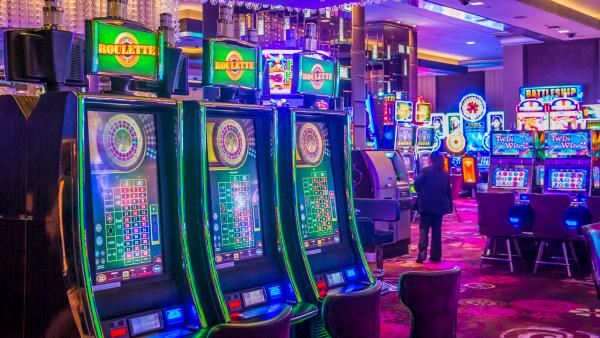
Everything Is Gambling And We'd Be Better Off Admitting It
Loot boxes aren't gambling, prediction markets aren't gambling, buying stocks isn't gambling, but all of this is ... gambling.

A group of gamers spent nearly 20,000 euros on loot boxes in an Electronic Arts FIFA video game over the course of four years, then took their case all the way to the Austrian Supreme Court, arguing EA and Sony were running a gambling operation, and the court said: Nah, they’re good. Not gambling.
The ruling hinged on the idea that loot boxes can’t be looked at by themselves outside the broader game, and the court said, "The player can, through their own skills -- namely, their chosen tactics and strategy, as well as their dexterity in operating the controller -- control the course of the game with a probability suitable for success, thus establishing a rational expectation of winning.”
Basically, because you need skill to win at the actual game, the whole loot box thing is not gambling.
The Austrian Supreme Court is wrong.
A guy drops $20,000 on randomized digital packs that may or may not contain the virtual Lionel Messi he desperately needs, and this is not gambling? Come on. If I take $20,000 to Atlantic City and play poker, which also involves skill, no one on the planet wouldn't call that gambling and my wife would call that “divorce.”
Here's the thing, though. It's not just the Austrian Supreme Court that has this wrong. Pretty much everyone gets it wrong. Because everything is gambling. And we'd all be a lot better off if we just admitted it.
The partial scorecard
Right now in the U.S., we have the most absurd war over what counts as gambling. An incomplete look:
Prediction markets: Not gambling. CFTC Chairman Michael Selig just withdrew the Biden-era ban proposal, directed staff to write friendlier rules, and is ready to go to bat for prediction markets in court. I can bet on how long MrBeast’s next video will be, but it's not gambling. It's a commodity derivative. Mmm-hmm.
Sweepstakes casinos: Gambling. Getting hammered on all fronts. The whole model was built on the legal fiction that trading digital coins for cash is legit. Nobody's buying it anymore.
Loot boxes: Not gambling. Austria's highest judges just said so. But EA pulled in $4.4 billion in "extra-content" live services in 2024, most of that in loot boxes, and it represented 60% of the company's revenue.
Blind box toys: Not gambling. Nobody's even asking. Meanwhile Pop Mart's on track for $4.2 billion in revenue, the rare "secret" Labubu hits at about 1-in-72, and gambling-treatment professionals have said the psychology is identical to a slot machine. But your kid can buy six of them at the mall before lunch.
Baseball cards: Didn’t used to be gambling. They were just something kids did for fun. Today? It’s 100% gambling.
So here's where we stand. Prediction markets: not gambling (federal government says so). Sweepstakes casinos: gambling (some states say so). Loot boxes: not gambling (most courts say so). Blind box toys: not gambling (nobody's even really asking). Baseball cards: not gambling, but 100% gambling. Sports betting at a licensed sportsbook: gambling. Sports betting on a prediction market: not gambling.
If you can make sense of this, you're smarter than I am. And you're smarter than the roughly 8,372 lawyers currently billing hours trying to sort it all out.
But let's keep going, because it gets worse.
Stonks!
You think buying a "yes" contract on Kalshi for whether Trump will tweet before noon is a gamble? What do you think happens when you buy options on Tesla? You're betting that the stock will move in a particular direction by a particular date. If it doesn't, your money is gone. Poof. This is how options work.
"But that's investing," people say. Sure. But when you throw $2,000 at zero-day SPY puts because you saw a post on Reddit you liked, I don't know what to call that other than gambling. (I also don’t know what “zero-day SPY puts” are; thank you very much ChatGPT for the example.)
Then there’s the biggest gamble most people ever make: your house.
You buy a house. You're betting on the neighborhood. You're betting on interest rates. You're betting on the local economy, on the school district not going sideways, on the foundation not cracking, on the market not tanking the year you need to sell. You're placing a six-figure bet -- on borrowed money, no less -- on a physical structure you inspected for 45 minutes.
In 2008, millions of Americans found out their "safe investment" was not so safe.
But nobody says, "I gambled on a three-bedroom colonial." They say, "I bought a house." Sounds better. The math isn’t different, though.
And then there's … everything
Took the job across the country instead of staying put? Gamble. Asked that person out instead of the other one? Gamble. Chose the fish over the steak or lasagna? Low-stakes gamble, usually, but the principle holds.
Every decision you make in which you can't know the outcome is, on some level, a bet. You're putting something on the line, be it money, time, emotional energy, your digestive system, what have you, and hoping it works out. You might have information. You might have skill. You might have a gut feeling. But you don't have certainty. And the absence of certainty is what makes it a gamble.
Now what?
Here's where I'm supposed to moralize or demand regulation or wring my hands about the children. I'm not going to do that.
What I am going to say is this: The endless war over what is and isn't gambling is missing the point.
Everything involves risk. Everything involves uncertainty. Everything is, on some level, a bet.
The problem isn't gambling. The problem is that we've decided gambling is a dirty word, while building an entire economy on products and decisions that are structurally identical to gambling, but don't carry the label.
A guy can spend €20,000 on digital mystery boxes and the Austrian Supreme Court says that's fine, because there's skill involved. But if that same guy walks into a casino and plays $20,000 worth of poker, that's gambling and we should be very concerned about him.
A kid can blow through $200 chasing a 1-in-72 Labubu and that's called collecting. But if that same kid downloads a sweepstakes app? Pearls, clutched.
We're not protecting anyone with these distinctions. We're just making ourselves feel better about the bets we've already decided are OK.
Maybe the better move is to just be honest about it. Teach people, starting with little kids, that all of life is a series of calculated risks. That every transaction, every decision, every sealed box has an element of chance. That the question isn't "is this gambling?" but "do I understand what I'm risking, what I might get, and what the odds are?"
Because if the CFTC says prediction markets aren't gambling, and the Austrian Supreme Court says loot boxes aren't gambling, and nobody on Earth thinks buying a house or picking a stock or grabbing the mystery toy at Target is gambling, then either nothing is gambling or everything is.
I'm betting on the latter.

Jeff Edelstein is a longtime columnist, reporter, radio host, and fantasy sports aficionado, not necessarily in that order. He lives in New Jersey with his family.