Paylines And Blurred Lines: In Sprawling Online Casino Ecosystem, Consumer Demand Is The Constant
What distinguishes social casinos, sweepstakes casinos, real-money iCasinos, and others?

13 min
Last updated: May 4, 2026 | Last verified: May 4, 2026
Paylines and Blurred Lines: In a Sprawling Online Casino Ecosystem, Consumer Demand Is the Constant
What distinguishes social casinos, sweepstakes casinos, and real-money iCasinos? The question was already pressing when this piece was first reported, in January 2025. Since then, six states have passed explicit bans on sweepstakes casinos, and the industry entered 2026 with a dramatically smaller U.S. footprint. The original reporting and sourced quotes are preserved below; the piece has been updated throughout to reflect what happened next.
On Dec. 4, 2024, Google unlocked a digital velvet rope it had kept firmly closed: the search giant began allowing social casino operators to run personalized ads, lifting them out of its restricted “Gambling” sensitive-interest category. The policy change, announced in November 2024, gave social casino app campaigns access to the full suite of Google’s targeting tools for the first time, with full rollout to all advertisers expected by March 2025.
Still locked out as of that date: real-money regulated casinos, sweepstakes casinos, cryptocurrency casinos, and offshore black-market operators. All remained confined in the sensitive-interest bucket, prohibited from personalizing ads.
That distinction, between pure social casinos and everyone else, turned out to be a preview of a much larger argument. By the end of 2025, it wasn’t just Google parsing the difference between casino types. State legislatures were doing it too, and several of them had reached a verdict.
In a rapidly evolving online casino ecosystem, where operators adhere to wildly different rules across sprawling international footprints, the question of what separates a social casino from a sweepstakes casino from a regulated real-money platform has become a legal, commercial, and political flashpoint. Not just for Google, which positioned itself to collect significant advertising revenue from a category generating an estimated $10 billion annually; the demarcation lines are being drawn in model legislation, regulatory enforcement actions, courtrooms, and investor boardrooms.
⚠️ Watch Out: The legal status of sweepstakes casinos changed materially in 2025. As of January 1, 2026, California, Connecticut, Montana, New Jersey, and New York have all enacted explicit bans on dual-currency sweepstakes operations. Nevada passed legislation giving regulators stronger enforcement tools, effectively forcing most sweepstakes operators out of the state. Before playing on any sweepstakes platform, verify that it operates legally in your state.
🎰 Reel Similar: What All Three Casino Types Share
Having flagged some of the differences, the similarities between social casinos, sweepstakes casinos, and regulated real-money online casinos are worth dwelling on. The list is longer than most people expect.
On pure social casinos like Slotomania, the flagship app from Playtika, users can spend significant money. The games don’t pay out cash, but the currency of entertainment, distraction, competition, and advancement through levels, flows freely. Players can, and do, lose thousands of dollars chasing more gold coins.
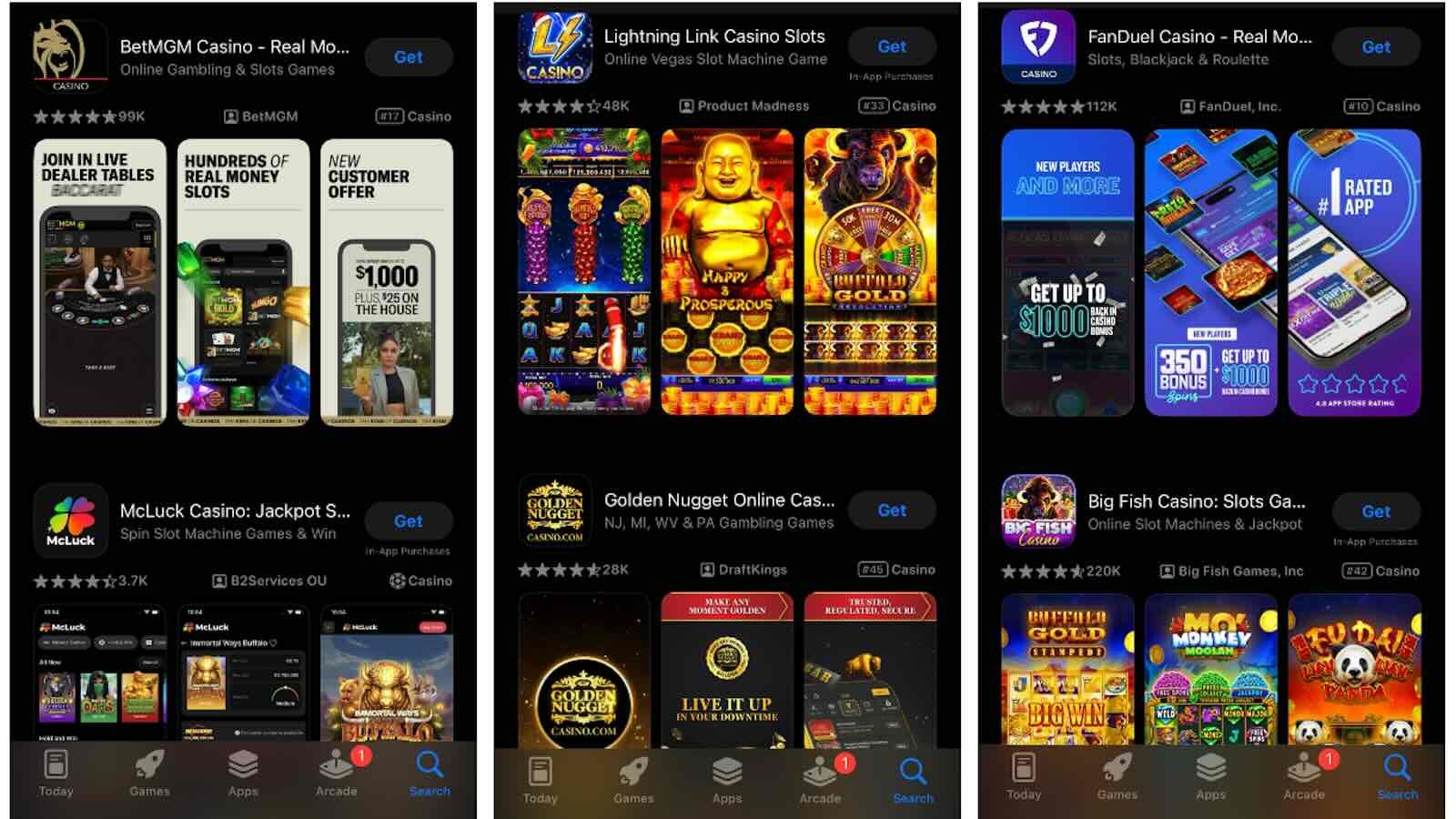
All three casino types offer largely the same game library: enormous catalogues of slot machine titles, selections of digital table games, and, on some platforms, live-dealer games powered by real human dealers in studios. The game content is increasingly shared as well. In December 2024, Playtika announced a partnership with International Game Technology (IGT), one of the dominant real-money slot machine suppliers, to bring IGT titles into Slotomania, Caesars Slots, and House of Fun. Cleopatra II, one of IGT’s most recognizable titles, began appearing in Slotomania on December 26, 2024. The same game sits in the lobbies of FanDuel Casino and BetMGM Casino, where there are no pretenses about coins or currencies.
The strongest common thread across all of them, including the crypto outfits and offshore black-market sites, is demand. Overwhelming, durable, state-line-ignoring demand.
Allan Stone, president and co-founder of Acquire.bet, a company that studies consumer behavior for gambling operators, put it plainly when I spoke with him for the original version of this piece:
“At our core, we are consumer behavioral scientists, and one thing I can tell you that’s universal: People want these products. In our view of the world, where gambling is competitive entertainment, call it what you want to call it, those are all forms of competitive entertainment. At the end of the day, people are putting money down in order to be entertained. That’s all it is.”
What he described has only become more visible in the time since. The more states try to restrict one category of online casino, the more clearly consumer demand announces itself.
💡 Pro Tip: Real-money regulated online casino games are legal in seven states as of mid-2026: Connecticut, Delaware, Michigan, New Jersey, Pennsylvania, Rhode Island, and West Virginia. Maine legalized online casinos but the market had not yet launched as of this writing. ⚠️ VERIFY: Confirm Maine launch status before publishing.
💰 Social and Profitable: The Business Behind the Games
Before Google’s advertising shift, the company grouped social casinos alongside all other casino types in its “sensitive interest” gambling category, where personalized targeting was prohibited.
“The Gambling in personalized ads sensitive interest category will be updated to explicitly exclude social casino game App campaigns,” Google wrote in a November 2024 post announcing the change, with the new rules taking effect December 4.
The companies that stood to benefit most from the new targeting capabilities include the eight biggest social casino game makers, according to Eilers and Krejcik Gaming:
| # | Company | Notable Brands |
|---|---|---|
| 1 | Playtika | Slotomania, Caesars Slots, House of Fun |
| 2 | Pixel United (Aristocrat Gaming) | Lightning Link Casino |
| 3 | SciPlay (Light & Wonder) | Jackpot Party Casino |
| 4 | Netmarble | |
| 5 | DoubleU Games | |
| 6 | Take-Two (Zynga) | |
| 7 | AppLovin | |
| 8 | PlayStudios |
Eilers and Krejcik Managing Director of Digital and Interactive Gaming Matt Kaufman explained what drives roughly $10 billion in annual revenue for the social casino industry:
“The overwhelming driver of monetization for all social casino companies, whether using a traditional model or leveraging a sweepstakes model, is sale of in-game currency. People purchase coins, and the coins extend your ability to play the games.”
“Sale of currency allows people to have premium experiences or to extend their gameplay,” Kaufman continued. “Having more currency can also sometimes have benefits with respect to meta features like clubs and leaderboards, where users compete with other players. Some social casino platforms also sell access to in-game features or purely aesthetic items like avatars, but those typically represent a very small portion of revenue compared to sale of coins.”
In Kaufman’s view, the similarities between social and sweepstakes casinos vastly outweigh the differences. Regardless of the specific monetization model, the underlying products are social casinos. The mechanics differ; the games do not.
Light and Wonder’s Head of Government Affairs, Howard Glaser, drew a harder line when I asked him:
“It’s not complicated. In sweeps, you pay real money for a chance to win cash money. In social you don’t. That’s it.”
He’s right about the mechanics. What he didn’t anticipate, perhaps, was how many state legislators would eventually agree with him, and decide that the distinction warranted a ban rather than a shrug.
⭐ Soccer Moms and Male Whales: Who Actually Plays
The vast majority of casino play across all three categories centers on slot games. Picture the average person who has downloaded and actively plays Slotomania or Jackpot Party Casino. If you have in mind a woman 35 and older, perhaps your quintessential “soccer mom,” that’s the most common profile, per industry sources. Men dabble plenty, and the biggest spenders are typically men, but female players on average drive higher lifetime values to the operator, according to Stone.
What’s striking, and Stone made this point directly, is how similar the behavioral profile looks regardless of which category of casino a player uses:
“It almost doesn’t matter to the players what the mechanic is: whether it’s social, sweepstakes, or real money. At the end of the day, it’s the same to them. Other than the fact that with sweeps and with social casinos, they might be artificially limited in terms of what they can do or access, because of how those products are priced. Otherwise, player behavior doesn’t skew in terms of average session duration. The time-spent comparables across those three verticals are virtually indistinguishable.”
Stone also flagged at least one structural advantage that social and sweepstakes casinos hold over real-money platforms: the power of scarcity. Some content on social and sweeps platforms is locked, accessible only after hitting certain thresholds of spins or coins earned. On real-money casinos, where players are wagering actual money, they expect access to the full game catalogue without an additional time or coin cost. Social platforms can manufacture a reason to keep coming back. Real-money platforms generally can not.
“They can artificially create some scarcity that incentivizes a deeper connection to the game,” Stone said.
And on the engagement mechanics side, sweepstakes and social casinos have generally outperformed their real-money counterparts at surfacing what Stone called “the hooks.”
“In the real money world, maybe they’ll display a little meter on the side that you need to fill up and when it does, it’ll trigger a bonus. That meter is just there. Whereas in the social and sweepstakes casino world, they’ll actually draw your attention to it, that you’ve almost reached it, and build some excitement. They’ve just done a better job of calling attention to some of the hooks that make those products more engaging, sticky, and interesting.”
One more thing Stone noted, and which I keep coming back to: whether or not players can actually win money may matter far less than the industry assumes.
“Whether users can actually win money back, that’s just the mechanic. What we have found about user behavior is that the ability to win money does not create or deter any type of additional incentive for the user. It’s almost as if users know that they’re simply playing to be entertained. If they can win money, great, but at the end of the day, as long as they’re getting commensurate value for the money they’re putting down for entertainment, they’re OK with it.”
⚖️ 2025: The Year the Crackdown Came
When this piece originally ran, in January 2025, the VGW lawsuits and state-level skirmishing felt like warning shots. They weren’t. They were the opening of a sustained legislative and regulatory offensive that reshaped the sweepstakes casino industry inside of twelve months.
The timeline is worth sitting with:
| When | What Happened |
|---|---|
| May 2025 | Montana became the first state to pass an explicit statutory ban on dual-currency sweepstakes casinos. |
| June 2025 | New York Attorney General Letitia James sent cease-and-desist letters to 26 sweepstakes platforms. All 26 stopped sweepstakes coin sales in the state. Connecticut and New Jersey passed bans. |
| Oct. 2025 | California Governor Gavin Newsom signed AB 831, banning dual-currency sweepstakes operations statewide effective January 1, 2026. The bill passed the state Senate 36-0 and the Assembly 79-0. California accounted for roughly 20% of the sweepstakes industry’s U.S. revenue. |
| Dec. 2025 | New York Governor Kathy Hochul signed S5935A, formally banning sweepstakes casinos in the state. Nevada passed legislation giving regulators stronger enforcement tools, effectively pushing most operators out. |
| Jan. 1, 2026 | California and Connecticut bans took legal effect. All major sweepstakes platforms had already exited both states. |
The California ban, in particular, is hard to overstate. The state has more than 39 million residents. Losing it knocked out roughly a fifth of the industry’s entire U.S. addressable market, by some analyst estimates. The legislation passed with unanimous votes in both chambers, backed heavily by California’s tribal gaming interests, who argued that sweepstakes platforms had been operating in violation of their exclusive gaming compacts without contributing to the state’s tax base or responsible gambling infrastructure.
AB 831 also set a new template. It didn’t just ban operators; it extended criminal liability to vendors and partners, including payment processors, geolocation providers, game content suppliers, platform providers, and media affiliates who “knowingly and willfully” support these operations. Violations are misdemeanors carrying penalties of up to one year in jail and $25,000 per violation. That has implications well beyond California.
Louisiana’s governor vetoed a ban bill that passed the legislature, but then the state’s attorney general opined that sweepstakes casinos were unlawful anyway, and the Louisiana Gaming Control Board sent 40 cease-and-desist letters to unregulated operators. Maryland and Mississippi regulators sent similar letters. Arizona and Michigan contributed to a national total that exceeded 100 cease-and-desist letters to sweepstakes platforms across 2025.
🔑 Bottom Line: Six states passed explicit statutory bans in 2025: Montana, Connecticut, New Jersey, California, New York, and Nevada (enforcement-based). Several dozen more states sent cease-and-desist letters or opened enforcement proceedings. The industry entered 2026 with a dramatically reduced U.S. footprint and no clear legal path to recovery in the states that banned it.
⚖️ The VGW Legal Story Keeps Expanding
When the original version of this piece ran, VGW faced two RICO lawsuits, one filed in New Jersey federal court and one in the Southern District of New York on December 3, 2024, the latter notably naming Apple and Google as co-defendants alongside VGW’s Chumba Casino, LuckyLand Slots, and Global Poker brands.
That was, it turned out, the opening act.
By mid-2025, VGW faced more than 20 active lawsuits nationwide. In April 2025, a class action was filed in Montana by spouses of players, not players themselves, seeking compensation for financial and emotional harm. The strategy was designed specifically to sidestep arbitration clauses that the players themselves had agreed to. In August 2025, a 129-page complaint in Northern California named not only VGW but its CEO personally, along with payment processors and an influencer. The New York AG’s action in June forced VGW, along with 25 other platforms, out of the state entirely.
VGW did score meaningful legal victories in Georgia, where a federal judge dismissed three separate lawsuits primarily on jurisdictional grounds, ruling that VGW’s minimal state presence was insufficient to establish court authority over the Australian-based company. In 2023, VGW had settled a Kentucky class action for $11.75 million. The settlements and procedural wins keep coming; so do the new complaints.
One attorney in the industry who spoke on background captured the dynamic early and accurately: “Litigation has never been a particularly winning strategy for stopping an industry.” That remains technically true, but the legislative route is proving far more effective. The plaintiffs’ lawyers may agree with the assessment. The California tribes and the New Jersey legislature did not need a courtroom to accomplish what dozens of lawsuits hadn’t.
📱 The Mobile Web Calculation
Most sweepstakes casinos run on mobile web rather than native apps, and the reason is straightforward: app store fees. Apple and Google both take 30% of revenue from in-app purchases and subscriptions on downloads occurring within their stores. For sweepstakes operators, whose prize payouts had grown from roughly 50% of deposits in 2019 to closer to 75-80% by the mid-2020s (per an analysis by Regulus Partners’ Paul Leyland), that 30% cut becomes commercially untenable.
“Because they need to get out of these steep app store fees, they’ve opted to make most of their products go with mobile web,” Kaufman said. “The majority of the products have chosen that route.”
The quality gap between native apps and mobile web has narrowed considerably. Stone described them as “almost indistinguishable” in terms of gameplay experience, a view Kaufman echoed with one qualifier: native apps still tend to be somewhat quicker and more responsive, and they can trigger push notifications and update silently in the background. Those aren’t trivial advantages for retention-focused operators.
But with California’s ban now extending liability to platform providers and payment processors, the distribution question gets more complicated. An operator that previously avoided native apps to dodge store fees may now face a world where mobile web distribution itself carries legal exposure in states that have passed vendor liability provisions.
⭐ Where Social Casinos Sit Now
Pure social casinos, the Slotomania and Jackpot Party Casino type, occupy a different position than their sweepstakes peers. Light and Wonder’s Glaser expressed “no concern whatsoever” when asked about regulatory risk to pure social casinos in January 2025. That stance appears to have held. The legislative bans in 2025 targeted dual-currency sweepstakes models specifically. Pure freemium social casinos, where there is no cash redemption at all, were not caught in the statutory language.
Attorney Bill Gantz, a Duane Morris partner who has represented sweepstakes casinos, made this point sharply in December 2024: “This is not just about sweepstakes, this is also about freemium too. All of those things said about sweepstakes are true about freemium [products]: It’s unlicensed, it’s unregulated, it’s been accused of irresponsible gaming, it’s been accused of underage access.” He added: “If you’re going to think about regulating any form of social casino, you should be regulating all of it. I think that’s kind of a glaring hole, personally, but maybe they’ll sort that out.”
As of this writing, they haven’t sorted it out. The model legislation drafted by the National Council of Legislators from Gaming States (NCLGS) included a provision banning sweepstakes casinos but left freemium products untouched. Whether that changes as state legislatures return in 2026 remains an open question.
Meanwhile, Google’s December 2024 advertising policy change gave pure social casino operators a concrete, measurable advantage over their sweepstakes competitors: access to personalized targeting on the world’s largest search platform. What that advantage is worth in the long run partly depends on whether the companies wielding it can keep their products out of the regulatory crossfire.
The irony is that not all of the top-eight social casino makers stayed purely on the social side. PlayStudios launched its sweepstakes platform, The Win Zone, in Q3 2025, right in the middle of the legislative crackdown. By Q4 2025 it was live in all “currently permissible jurisdictions,” covering 15 states where no ban had taken effect. None of them were California, New York, New Jersey, Connecticut, or Montana. CEO Andrew Pascal acknowledged in November 2025 that the bans had reduced the total addressable sweepstakes market by roughly 25%, but called the remaining states a “$3.5 to $4 billion” opportunity. As of March 2026, PlayStudios was targeting a sweepstakes integration into its POP! Slots app for late Q2 2026. Pascal’s position, that some form of regulated sweepstakes will survive and ultimately be taxed and licensed, is a reasonable bet. What survives to be regulated, and in which states, is the harder question.
🏆 The Question That Hasn’t Changed
The regulatory environment shifted dramatically between January 2025 and the start of 2026. The fundamental consumer behavior question has not.
Stone’s observation from the original reporting holds as well now as when he said it: “The user is agnostic, so much so, for example, that even black market real money casinos still attract money.”
Regulated online casino gaming remains legal in seven states: Connecticut, Delaware, Michigan, New Jersey, Pennsylvania, Rhode Island, and West Virginia. That accounts for a small fraction of the U.S. population. The rest of the country’s appetite for online casino-style entertainment goes somewhere. Some of it went to sweepstakes casinos. Some of that segment has now been displaced by legislative action. Where it goes next, whether to regulated platforms as more states legalize, to offshore operators, or simply to an industry that adapts its model again, is genuinely unclear.
Kaufman’s earlier analysis of sweepstakes and social casino cannibalization gets more interesting in this light. Research from Macquarie had suggested that sweepstakes platforms were drawing users away from pure social casinos rather than from regulated real-money operators, implying that a significant portion of the sweepstakes player base was there precisely because legal iCasino wasn’t available to them. If that’s true, then the California and New York bans didn’t eliminate demand. They redirected it.
Redirected to where? That’s the question policymakers, operators, and investors are all watching in 2026. And the direction it goes seems, as it did a year ago, less likely to be determined in the courts than in the court of public opinion.
🛡️ Responsible Gambling
Online casino products, in all their forms, carry genuine risk for some users. The VGW litigation has put a public face on that risk, with allegations that platforms induced, aided, and enabled users who were showing clear signs of addiction to continue playing. But VGW is not alone. Regulated operators including DraftKings and BetMGM have each faced lawsuits alleging that VIP hosts aided problem gamblers rather than intervening.
Licensure and regulation are only as strong as the laws on the books, the regulators enforcing them, and the operators granted licenses. That applies to every category covered in this piece.
If you or someone you know is struggling with gambling, free, confidential help is available.
🛡️ Responsible Gambling Resources: National Council on Problem Gambling Helpline: 1-800-522-4700 (24/7, call or text). 1-800-GAMBLER (1-800-426-2537): Available in NJ, PA, MI, WV, and other regulated states. NCPG: ncpgambling.org. Most regulated online casino platforms allow you to set deposit limits, cooling-off periods, and self-exclusion options directly in your account settings. Use them.
This piece was originally reported and written by Brett Smiley and published in January 2025. It has been substantially updated in May 2026 to reflect the sweepstakes casino legislative wave of 2025, the current state of VGW litigation, and updated regulatory state counts. Sourced quotes from Allan Stone (Acquire.bet), Matt Kaufman (Eilers and Krejcik), Howard Glaser (Light and Wonder), and Bill Gantz (Duane Morris) are preserved from the original reporting.