Schuetz: Dealing Keno Stoned, Truckers With Firepower, Sending Stupak A Message
A 50-year veteran of the casino trenches shares a trio of memorable stories and lessons learned

11 min
When you’ve been in the casino business as long as I have, you’re sure to have accumulated your share of stories.
In this article, I’ll recall three of my favorites — and the lessons learned from each.
Working keno and doing a doobie
I was recently doomscrolling through X (formerly Twitter) and came across a tweet about keno. That immediately jump-started my brain to a time long ago.
In 1971, I was in college and needed money. I was lucky enough to secure significant financial support from the Scholarship and Financial Aid Office at the University of Nevada Reno. The U.S. Army also provided several valuable scholarships. Despite these benefits, I was always ridiculously broke.
When I turned 21, I thought I would do what many UNR students did and get a job in a casino. The industry was always hiring and since the casinos never closed, it was fairly easy to secure a position that was compatible with attending school during the day.
I went to the classy Harrah’s Reno. This was a time when it was possible to occasionally see Bill Harrah himself in the building. I was the type of person Harrah’s organization seemed to be looking for. They loved the clean-cut college look and they hired so many of us, we used to laugh that we all had interchangeable parts.
I was hired as a keno writer, an entry-level position. In addition to all my personal information, I had to provide fingerprints — my first insight into the regulated nature of this industry.
I was also informed by Harrah’s that I needed to attend a two-week class to understand what it meant to be a keno writer. Another attribute of Harrah’s, back in those days, was its commitment to providing in-house training for all its workers. We joked that there was the right way to do something, the wrong way to do something, and the Harrah’s way to do something.
Beyond the joke, however, this was a highly progressive approach to compliance.
It is a daunting task for a supervisor to monitor the large volume of transactions in a casino environment. Given this, one notices things that are different or seem out of place. There is a rhythm to a casino floor and if everyone is reading from the same sheet of music, it is easier to spot someone playing off-key. If an employee was not performing a function according to our procedures, it could cost the store in terms of inefficiencies or, worse, be part of a scam. That is why the organization wanted everybody to do things the same way.
As an aside to the above, I later moved into dealing, then supervising, cards and dice. At this time, we dealt handheld single-deck blackjack and it was hard to watch a left-handed dealer. Nothing ever looked right. Used to drive me nuts.
“There is a rhythm to a casino floor and if everyone is reading from the same sheet of music, it is easier to spot someone playing off-key.”
But first, I put in my time at keno. This game is a hoot. One can find it here and there today in an electronic format, generally on the slot floor. In my day, it consisted of a counter with several stations where the keno writers to sat and a lounge for the players.
The players marked their lucky numbers with a crayon on a white sheet of paper listing the numbers 1-80. Then, they took that ticket to the counter, where someone like me made a copy of their numbers on a ticket with a Chinese paintbrush dipped in India ink and return it to the customer.
What made the game popular were its low entry price (60 cents in 1971) and slow pace, so it did not burn through a bankroll too quickly. Plus, if the keno gods were smiling upon you, it was a potential serious payday, with a max jackpot of $25,000.
Behind the keno counter was a big fishbowl-like container with ping-pong balls numbered 1-80. A blower pushed 20 of the balls into rabbit ears; the numbers were announced, one at a time, over the public address system. They were also displayed on electronic keno boards at various locations around the property. The players then checked their tickets to see what they won.
Aside from the fact that it paid very little, working in keno was cool. It was a nice society and reasonably loose behind the counter. I worked swing shift, 6 p.m. to 2 a.m. During this time in my life, typical of the era, I smoked a little reefer while I walked to work. This led to my most interesting keno experience.
I had just started my shift, was working a cool high, and it was my time to select the balls. A bit impaired by the grass, I was really concentrating, and it seemed like hitting the lever to advance the balls into the rabbit ears, then calling the number, was taking forever. Paranoia set in and I believed I’d advanced and called something like 40 or 50 numbers … and the whole casino was staring at me. I could already foresee the morning headline: “Harrah’s calls 50 keno numbers, all hell breaks loose.” When I was finally done, I shut everything down, leaned against the wall, and dared to look around.
No one was doing anything different than normal. I had only advanced and called the 20 numbers required and the only person who thought something was wrong was me.
One lesson learned: Roll smaller joints to smoke on my way to work.
Check your weapons here
In the late 1970s, I took a job at a small Reno casino and earned several quick promotions. I would like you to believe my brilliance and good looks helped me climb the company ladder. The reality was that the property was so poorly managed, the turnover was fast and furious. Anyone could move up the organizational chart fairly quickly if they just hung around long enough. But I knew I was in well over my head and certainly wasn’t enjoying myself, so I quit.
I went out to Boomtown, which was a truck stop along Interstate 80 seven miles west of Reno. I knew a lot of the folks working there from when I was at Harrah’s and they were all happy. This truck stop could park 800 18-wheelers and had showers (important to truckers), along with hotel rooms, a laundromat, dozens of fuel pumps, a huge buffet, 1,000 slot machines, and 44 table games.
I hired on as a blackjack and dice dealer, and this was a great place to work because the toke policy was “go for your own” and the tips were good.
Most casinos at this time pooled tips by shift. That is, the tips raised on swing shift went to the swing shift dealers who dealt on that shift, the tips collected on days went to the dealers who worked that shift, etc. While that smoothed out our variance, it also gave the IRS a pretty good idea of what everyone was making, which was not good for go for your own. At Boomtown, I might have an $18 night or a $300 night. So when I filed my taxes, I did not declare a lot, since the tips were different for each employee; it was hard to prove that anyone was being less than honest.
At Harrah’s, I was once part of a large IRS audit targeting all dealers, and they had a very good idea of what we made. It seemed the IRS had leaned on some people to get that information. We did not know they had very good information, so we all generally under-declared tip income.
Well, just about every Harrah’s dealer had to clean up the mess that underreporting had caused them and write the IRS a big check, resulting from the audit. My circumstance was that I had left Harrah’s and gone on to graduate school at the University of Utah in Salt Lake City. My audit was transferred to the IRS office in Salt Lake City. The guy handling my case had no interest in it and basically told me not to worry, then closed it. God smiled upon me.
So Boomtown was cool, because everyone came up with different tips, which made for a difficult audit. However, the party was over when the IRS came, met with all of the dealers, and gave us the opportunity to sign an agreement that basically said they would look beyond our past behavior as long as we were honest going forward.
Well, I clearly understood that the party was over, so I immediately signed this agreement, then quickly requested to move into management, where I would get a salary and could avoid the risk of annoying the IRS.
“The party was over when the IRS came, met with all of the dealers, and gave us the opportunity to sign an agreement that basically said they would look beyond our past behavior as long as we were honest going forward.”
Boomtown made me a floor supervisor in table games, later a shift boss. That meant I would supervise dice and blackjack. It also meant I would be making less money than I was accustomed to.
Boomtown was decorated in a western motif. When I was working there, they added a poker room, because poker was becoming a thing. The new room held three poker games and they put cute western-style signs around the room. One was “Please Don’t Shoot the Piano Player.” Another was “My Barn, My Rules.” On the podium as you entered the room, a sign read, “Check Your Guns Here.”
Well, Boomtown was a truck stop, and at the time, it was considered the world’s largest. Another detail about truck stops is that they attract a lot of truckers with big trucks, and truckers with big trucks were typically packing. They all had weapons of some sort, as they were often out on the road and wanted to avoid having their loads hijacked or other issues that might arise where a gun might be handy.
So we opened our poker room and I was working the podium. In the first hour, three different dudes tried to check their weapons, and truckers seemed to prefer high-power hand cannons, like a .357 Magnum.
I told them to put away their sidearms, that the sign was a joke. Then I called maintenance to take the sign off the front of the podium.
Another important lesson: It’s crucial to understand your audience when communicating … even if it is only a joke.
The Stupak statue
It would be an understatement to suggest that Bob Stupak was a legend in Las Vegas and beyond. It would take several books to chronicle his life, but here is a short bio to give you a feel. What Bob was particularly known for was being a hustler, and there were many stories of his efforts in this area.
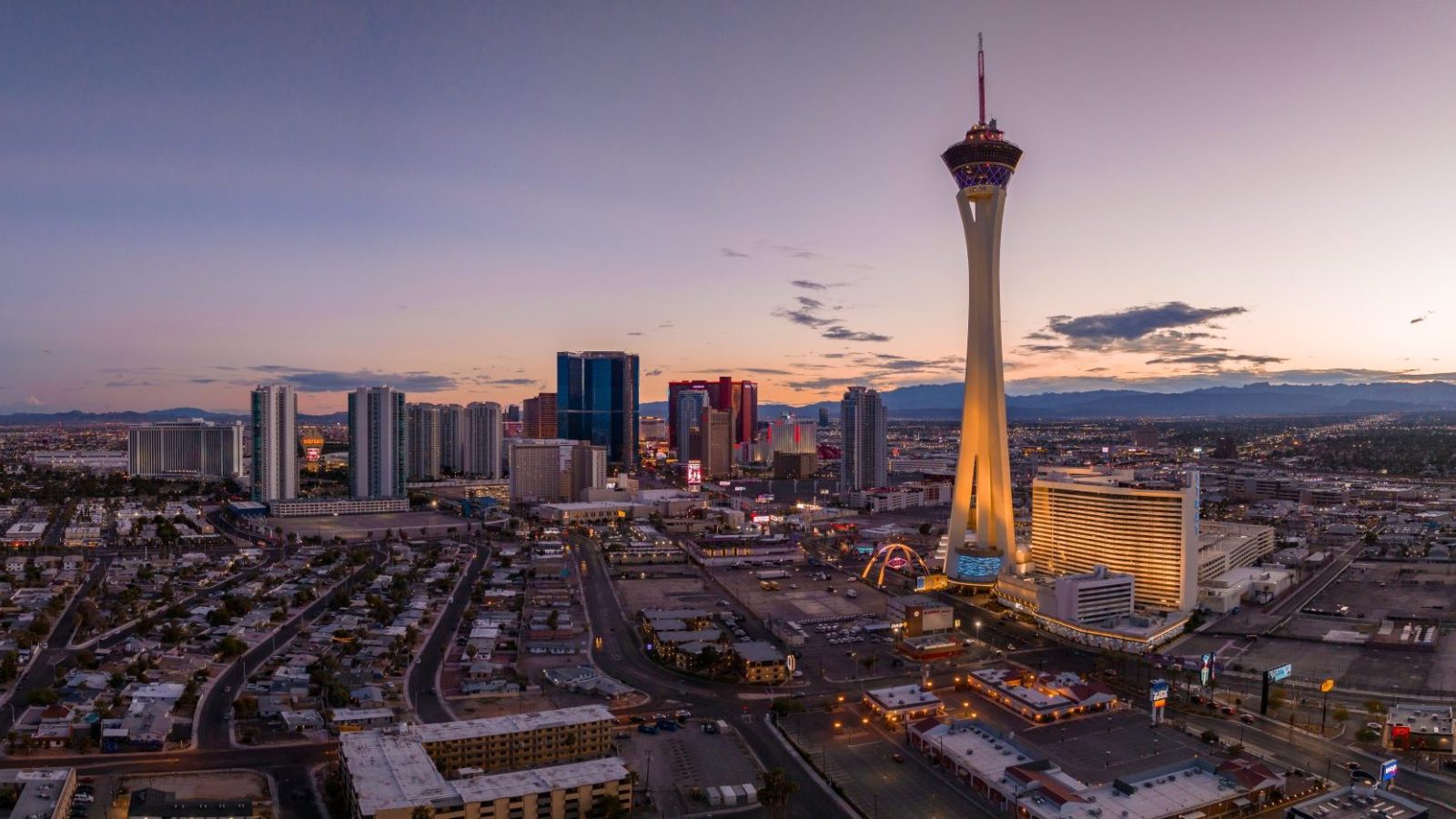
I ran into Bob from time to time as an executive in Las Vegas, but our paths really crossed when I was an executive at Grand Casinos. Bob was hustling money from my boss, Lyle Berman, to finish building the Stratosphere on the site of his former hotel-casino, Vegas World. Grand Casinos’ corporate office was in Minneapolis. At the time, I was responsible for Grand’s marketing for our six casinos, and I just did not see any way Bob could enhance our brand. In fact, my concern was just the opposite. I should note that Lyle and I were often on opposite sides of an issue.
Obviously, Lyle had a few more votes than I, and Grand took a big position in the Stratosphere.
I was around for the grand opening of the Stratosphere in April 1996 and was nonplussed. My five-year options were also vesting with Grand at that time; I resigned my position and got off the very hectic schedule I had been on for the last five years.
I bought a nice home on Lake Minnetonka, with a wonderful patio overlooking the lake, a dock, and all sorts of water toys. I was officially chillin’.
When I left Grand, I did maintain a consulting agreement with them, and was surprised when Lyle called and asked me to take another look at the Stratosphere.
I made my arrangements as a guest would, using the 800 number and all of that. My cover was that I was looking into another hotel-casino and wanted to stay at the Stratosphere. I played blackjack, rolled some bones, ate, and did everything a guest would do. I also found out where the dealers hung out to drink after swing shift and bought lots of drinks. After eight days of that, I returned to Minneapolis.
I wrote up a report of my observations for Lyle and did not hear anything from him for about a week. When he called, we spent about an hour on the phone. Two days later, he drove out to my home and kept talking about the Stratosphere.
Finally, he asked if I would take over as interim president, while he began a search for a permanent one. I said I would be happy to do that and asked when he wanted me to go. He said he was flying out to Vegas on the company jet in two days and he wanted me to be on it.
That was a bit quick, but two days later, I had all my suits ready for the car that picked me up and took us to the jet.
Later that day, I moved into one of the suites on the top floor, figuring I’d never leave the property. Lyle went and did the dirty work, informing the people who were going to be told they no longer worked there.
The next day, Lyle and I held a press conference. It was rather funny.
Gary Thompson, one of the reporters attending, asked an interesting question. During my presentation, I mentioned an eight-week turnaround plan. Gary asked what was so special about eight weeks, and I told him that at the current burn, I only had about eight weeks of cash left, and that if I had nine weeks of cash left, I would have a nine-week turnaround program.
Another reporter asked what I was being paid, and I answered honestly that I did not know. I thought that was a testament to Lyle’s and my relationship. While we often disagreed, I always understood Lyle to be honorable and I knew I would be appropriately compensated. There were more important issues before us.
One issue that became problematic early on was Bob Stupak. I had mentioned to Lyle that if I wanted Bob’s advice, I would find him. Well, Bob was starting to walk around, meeting with executives, board members, employees, and God knows who. I got on the phone and explained to Lyle that this needed to stop and it needed to stop now. Lyle said he would handle it.
Unfortunately, Bob remained Bob, and his behavior did not change.
On the property, there was a bigger-than-life bronze statue of Bob holding two dice. I called maintenance and told them to remove the statue from the floor and put it in the warehouse. I also invited a reporter up, and the statue was hauled out the door.
The next day, I received a call from Lyle, who was in Minneapolis. He said he thought Bob got the message.
Third lesson learned: Sometimes it is more effective to communicate without words.
—
Richard Schuetz entered the gaming industry working nights as a blackjack and dice dealer while attending college and has since served in many capacities within the industry, including operations, finance, and marketing. He has held senior executive positions up to and including CEO in jurisdictions across the United States, including the gaming markets of Las Vegas, Atlantic City, Reno/Tahoe, Laughlin, Minnesota, Mississippi, and Louisiana. In addition, he has consulted and taught around the globe and served as a member of the California Gambling Control Commission and executive director of the Bermuda Casino Gaming Commission. He also publishes extensively on gaming, gaming regulation, diversity, and gaming history. Schuetz is the CEO of American Bettors’ Voice, a non-profit organization dedicated to giving sports bettors a seat at the table.