WSOP Final Table Gets Off To Slow Start, Jason Koon Enters Poker Hall Of Fame
Seven remain in pursuit of championship bracelet, Jumalon still leads, ‘Gags’ and ‘FBT’ getting short

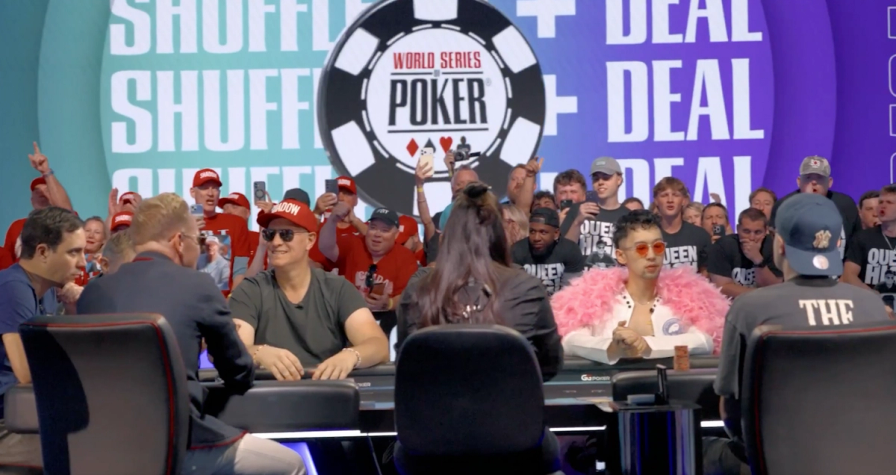
On Monday night at the Horseshoe Las Vegas, nine became seven, and eight became one.
The first of three days of play at the World Series of Poker Main Event final table featured a fair amount of conservative maneuvering and only two eliminations, leaving seven contenders in the hunt for the $10 million first-place prize. And during a break in the action, the WSOP announced the 2026 Poker Hall of Fame class — which, despite new rules designed to open the door for two or three of the eight finalists to go in at a time, turns out to be another class of one, high-stakes standout Jason Koon.
Lucas Jumalon came to the final table as the chip leader and has yet to relinquish that lead, chipping up slightly over the course of the day from 194 million to 212 million, but losing strength in a relative sense. He went from 129 big blinds to 85 and watched his lead over second place shrink.
Over the course of nearly six hours of play, only two competitors went bust: Evagoras Evagorou of Cyprus in ninth place (the same chip position in which he started the final table) and Frenchman Mario Boos in eighth. They earned $1 million and $1.25 million, respectively.

When play resumes Tuesday night (ESPN coverage begins at 8 p.m. ET), the two veteran bracelet winners at the final table will be among the short stacks. Michael “Gags” Gagliano is fifth in chips with 42 million (just 17 big blinds), while Greg “FBT” Mueller is the short stack with 29.5 million (12 bigs).
The complete chip counts at the end of Monday’s play:
| PLAYER | CHIPS |
|---|---|
Lucas Jumalon | 212,000,000 |
Han Feng | 106,500,000 |
Lauri Saaskilahti | 84,500,000 |
Rami Hammoud | 45,500,000 |
Michael Gagliano | 42,000,000 |
Jamie Sheaves | 33,000,000 |
Greg Mueller | 29,500,000 |
Highlight hands from the first day
Han Feng, flamboyantly outfitted in a pink feather boa, was the big winner of the day, going from the second-shortest stack to second in chips, with almost exactly half as many chips as leader Jumalon. The 27-year-old Texas pro Feng, who was all-in and at risk multiple times, got lucky in one key spot with A-4 against the A-Q of Boos to stay alive.
Evagorou busted on a classic pre-flop coin flip about three hours into the day’s play, his pocket jacks losing to the A-Q of Jamie Shaevel after an ace landed on the flop.
Boos hit the rail in similar fashion, shoving as a short stack with pocket eights and losing to Lauri Saaskilahti’s K-9.
Chip leader Jumalon, just 22 years old and vying to become the second-youngest Main Event winner ever, was the most active player at the table. He tried in spots to use his stack to bully opponents, but it frequently backfired and he was relatively card-dead for a long stretch of the day.
Mueller was particularly conservative with his play for most of the session. He made one incorrect fold on the river against a big bluff from Saaskilahti, reliquinishing top pair of kings in a spot that would have vaulted him into second place if he’d called.
Mueller’s fellow Canadian, Rami Hammoud, entered the day second in chips and ended it fourth out of seven, while earning a few laughs by occasionally putting on a pair of 2004 champ Greg “Fossilman” Raymer’s famous hologram glasses — gifted to him by Raymer, whom Hammoud eliminated on Day 5 of the tournament.
Hall of Fame: One and done
In June, the WSOP announced changes to its Hall of Fame election system, switching from inducting only the top vote-getter to inducting anyone who receives votes from at least 22 of the 33 electors. Conventional wisdom said that would result in two, maybe three finalists entering the Hall each summer, slightly reducing the backlog of deserving contenders.
But the first year of the new system produced results that looked a lot like the old system, with only Koon — newly eligible at age 40 — crossing the 22-vote threshold.
Many observers expected Shaun Deeb, also in his first year of eligibility, to get voted in, and same for Scott Seiver, in his second year since turning 40.
But it was only Koon, who has won two WSOP bracelets — both for high buy-in events, as tends to be his play preference. He won the $25K heads-up tournament in 2021 and a $50K high roller in 2025. He is well-known for his success in high rollers and super high rollers outside the WSOP realm, helping him to $77 million in career tournament winnings — good for No. 3 on the all-time money list.
“To be voted in by the greatest poker players of all time is one of the most amazing experiences of my life,” Koon told Jeff Platt on the ESPN2 broadcast.

Eric has been a professional editor and writer for more than 25 years, including nearly 20 years of experience covering the gambling industry. He was editor-in-chief of the poker magazine All In from 2005-2015 and manag…