The U.S. regulated online casino market is smaller than sports betting in terms of states (seven live, with Maine legalized but not yet launched, versus 35+), but it's the better business. Online casino games carry a built-in house edge, so revenue doesn't swing on game results the way sportsbook revenue does, and there's no off-season. That steadiness makes iGaming the more attractive business for operators and a significant tax revenue engine for the states that have authorized it.
This page tracks operator market share, state-level gross gaming revenue, and tax generation across the regulated U.S. online casino market. The charts and statistics below are presented by Casino Reports in collaboration with independent analyst Alfonso Straffon, a longtime industry observer, former sports trader, and equities analyst at Deutsche Bank. We update here on or about the third Thursday each month. You're seeing data through August 2026, which is the latest available.
For a deep dive into the sports betting side, visit our companion page: U.S. Sports Betting Market Stats Database.
Citation request. If you reference any data from this page, please support our work and cite this page with a link. Spotted an error? Reach out to brett@thirdplanet.us.
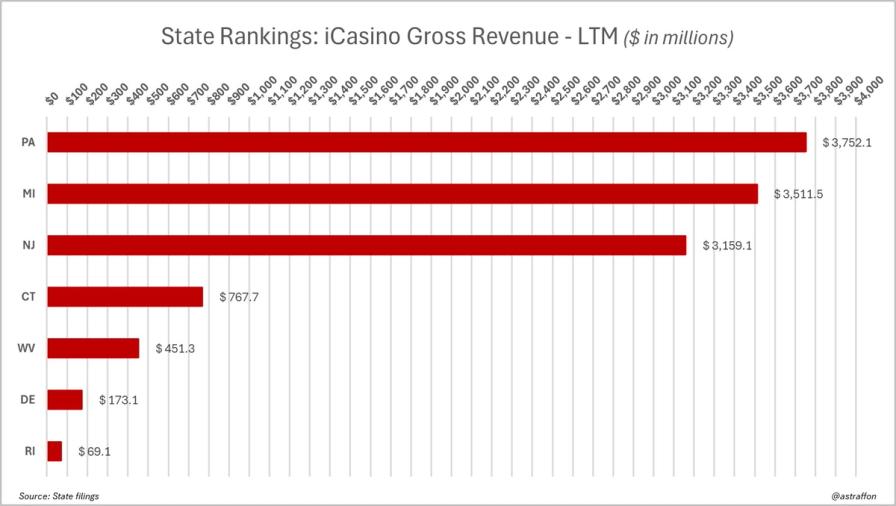
1. iCasino gross gaming revenue by state, last twelve months
Trailing 12 months: September 2025 through August 2026.
Key Insights:
- Pennsylvania leads the U.S. iCasino market with $3.75 billion in gross gaming revenue over the last 12 months, up from $3.72 billion in our last update. The trajectory remains consistent and upward.
- Michigan follows at $3.51 billion, about $240 million behind Pennsylvania. New Jersey is third at $3.16 billion, comfortably above the $3 billion threshold.
- Connecticut leads the second tier at $767.7 million, followed by West Virginia at $451.3 million, Delaware at $173.1 million, and Rhode Island at $69.1 million.
Pennsylvania, Michigan, and New Jersey have cemented themselves as the "revenue triad" in U.S. iGaming, each generating over $3 billion in annual GGR. Major operators and suppliers, including Playtech and Evolution Gaming, have established live dealer studios in all three states.
What's coming.
- Maine became the eighth state to legalize iGaming in January 2026 when Gov. Janet Mills allowed LD 1164 to pass into law without her signature. The law grants exclusive online casino rights to Maine's four federally recognized Wabanaki tribes, each of which can partner with one third-party operator. DraftKings and Caesars already have tribal sports betting partnerships in the state, giving them an inside edge. The 18% tax rate is competitive. The market has not launched yet, and a federal lawsuit from Churchill Downs-owned Oxford Casino Hotel, which was excluded from the law, remains a wild card for timing.
- The bigger question is still New York, and the answer is still "not yet." Sen. Joseph Addabbo Jr. introduced iGaming legislation for the fourth consecutive year in January 2026 (S2614), with an Assembly counterpart (A6027) from Assemblywoman Carrie Woerner. The bill proposed a 30.5% tax on GGR, well below the 51% sports betting rate but among the highest contemplated nationally for iCasino. It died when the legislative session ended in June.
Two obstacles that had previously blocked progress were cleared heading into 2026: the downstate casino licensing process wrapped in December 2025 (licenses awarded to Bally's Bronx, Resorts World NYC, and Metropolitan Park), and the state enacted a sweepstakes casino ban. But Addabbo acknowledged in late May that the bill had no path without Gov. Kathy Hochul's support, and the Hotel and Trades Council remains opposed over job cannibalization concerns. Expect another attempt in the 2027 session. If and when New York acts, it would instantly become the largest iGaming market in the country by a wide margin.
In Delaware, the state lottery replaced 888 with Rush Street Interactive at the end of 2023. In September 2024, Rush Street launched live dealer games through Evolution Gaming, available through all three of the state's licensed casinos.
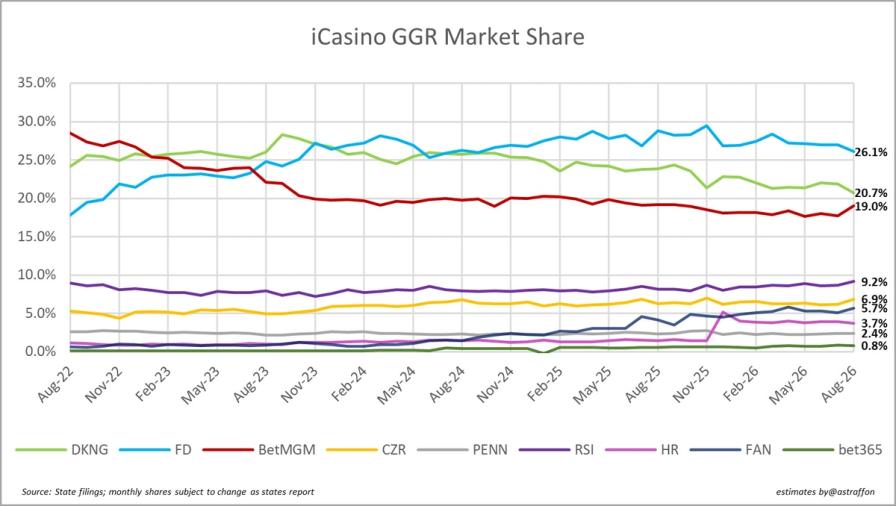
2. iCasino GGR market share by operator (last four years)
Monthly, August 2022 through August 2026.
Key Insights:
- FanDuel Casino remains the clear leader at 26.1%, though that's down from 27.0% in our last update and its lowest share since mid-2024. FanDuel set its record of 29.4% in November 2025. In February 2025, FanDuel went live with the exclusive Huff N' More Puff, a digital version of the wildly popular on-floor slot, which helped accelerate its share growth. FanDuel has also pushed World of Wonka and other exclusive titles.
- DraftKings Casino slipped to 20.7%, down from 21.9% and the lowest reading in our four-year window. DraftKings has been innovating with a form of peer-to-peer poker available in certain states through its casino app, while also expanding its content library and Golden Nugget Online Gaming and Jackpocket Casino brands.
- BetMGM jumped to 19.0% in August, up from about 17.7% in July, its best month since spring 2025. That puts BetMGM just 1.7 points behind DraftKings for second place, the narrowest gap since DraftKings overtook it in early 2023. BetMGM held 28% share in mid-2022 and lost roughly 10 points over the following three years, almost entirely to FanDuel and DraftKings. One strong month doesn't make a turnaround, but the slide appears to have stopped.
- Rush Street Interactive (BetRivers/PlaySugarHouse) continues to punch above its weight at 9.2% share, the highest in our four-year window. Frequently rumored as an acquisition target, RSI has held at roughly 8-9% for years.
- Caesars at 6.9%, matching its high-water mark, and Fanatics Casino at 5.7%, up from 5.3%, round out the mid-tier. Hard Rock sits at 3.7% after a jump in December 2025, and the Seminoles are also veering into products resembling iGaming in Florida, where they hold a state monopoly. PENN (2.4%) and bet365 (0.8%) trail the field.
Note on methodology. Revenues from multiple brands under the same parent company are combined. Flutter includes FanDuel and PokerStars; DraftKings includes Golden Nugget Online Gaming and Jackpocket Casino; BetMGM includes Borgata.
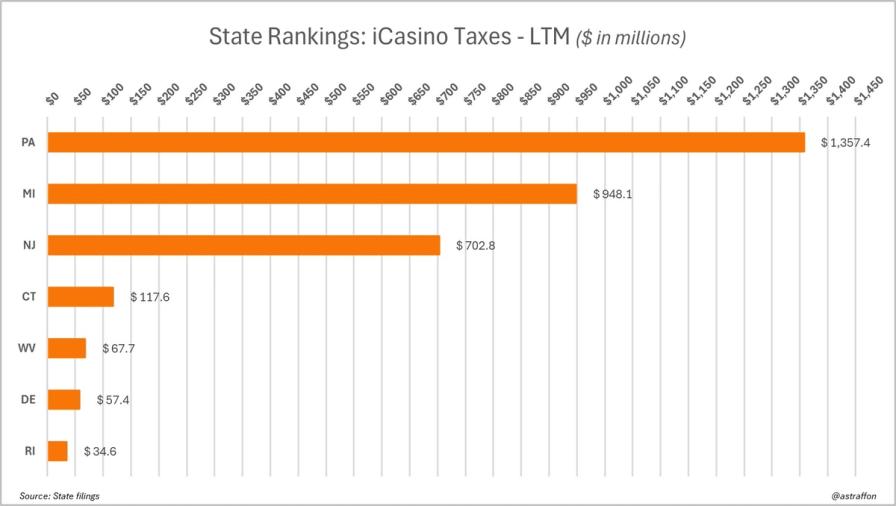
3. iCasino tax revenue by state, last twelve months
Trailing 12 months: September 2025 through August 2026.
Key Insights:
- Pennsylvania leads with $1.36 billion in iCasino tax revenue over the LTM, driven primarily by its 54% tax rate on online slot machine games. That single rate on slots carries most of the weight; table games and poker are taxed at a far more reasonable 16%.
- Michigan follows at $948.1 million, benefiting from a graduated tax rate that reaches 28% for the largest operators. Michigan regulators have also been aggressive in pursuing enforcement against unregulated and black market operators, intended to protect both citizens and the state's licensed operators.
- New Jersey generated $702.8 million. Gov. Phil Murphy's FY 2026 budget raised the iCasino rate from 17.5% to 19.75%, effective July 1, 2025, and the current LTM window runs entirely at the higher rate. Even so, New Jersey's effective tax take is about 22% of GGR, versus roughly 27% in Michigan and 36% in Pennsylvania.
- Connecticut leads smaller states at $117.6 million, followed by West Virginia ($67.7 million), Delaware ($57.4 million), and Rhode Island ($34.6 million). Delaware and Rhode Island, where the state lotteries run the market, keep a far larger share of revenue than any other iCasino state.
This chart, taken together with the GGR figures above, shows why New Jersey remains the friendliest of the big three for operators: it generates roughly as much GGR as its peers but taxes it at the lowest effective rate, though the 2025 increase narrowed that advantage. Pennsylvania's operators gross the most revenue overall, but the 54% slot tax significantly compresses their margins on that product.
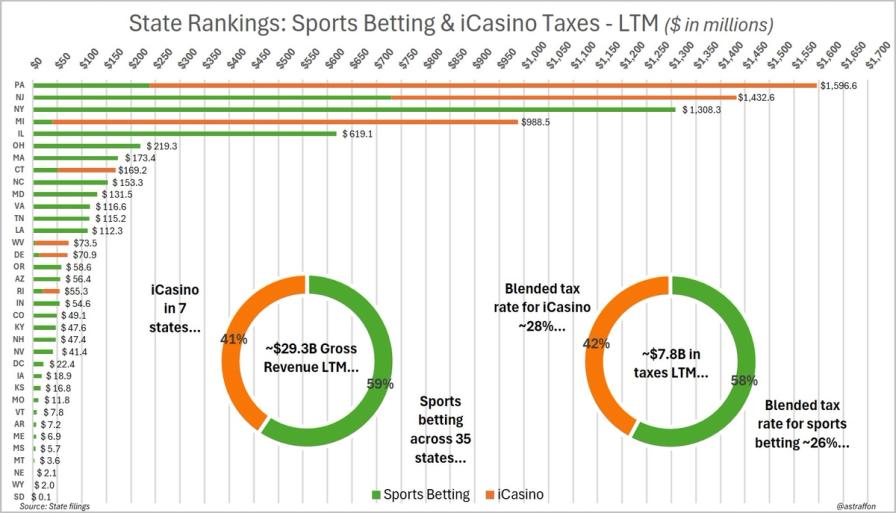
4. Sports betting and iCasino taxes combined, last twelve months
Trailing 12 months: September 2025 through August 2026.
Key Insights:
- The combined U.S. market generated approximately $29.3 billion in GGR and $7.8 billion in taxes over the trailing 12 months. iCasino, live in just seven states, accounts for 41% of that revenue and 42% of the tax dollars. Sports betting, across 35 states, accounts for the rest.
- Pennsylvania remains the combined tax leader at $1.60 billion, owing to its high iCasino slot rate stacked on top of a 36% sports betting rate.
- New Jersey has moved into sole possession of second place at $1.43 billion, pulling ahead of New York ($1.31 billion) after the two were in a virtual tie in our last update. New Jersey's rate hikes to 19.75% on both sports betting and iGaming, combined with a mature iCasino market generating more than $700 million in taxes on its own, have carried the state past the country's largest sports betting market. A few updates ago, NJ sat well behind NY.
- Michigan follows at $988.5 million, driven by its large iCasino market. Illinois at $619.1 million is purely sports betting, with no authorized iCasino. Connecticut ($169.2 million) shows how much iCasino can lift a small state: it ranks just behind Massachusetts despite a fraction of the sports betting handle.
- The juxtaposition of the two revenue streams underscores a basic market reality: revenue is higher and more stable for online casinos than for sports betting, even in the era of rising structural hold and heavy parlay activity. The blended tax rate for iCasino runs approximately 28% versus roughly 26% for sports betting, reflecting both higher state rates and the fatter margins that can absorb them. Sports betting has more states, more handle, and more public attention, but iCasino is the better business.
- If New York eventually legalizes iGaming at anything like the proposed 30.5% rate, this chart will need a much longer x-axis.
On the New York operator list. New York levies a 51% tax on gross sports betting revenue on its nine active operators: DraftKings, FanDuel, Caesars, BetMGM, Fanatics, theScore Bet (formerly ESPN Bet), Resorts World Bet, Bally Bet, and BetRivers. Monthly betting volume runs about $2.2 billion, translating to the tax haul you see on this chart.
Related. For the full sports betting breakdown, including operator handle and GGR market share, state-level rankings, parlay data, and quarterly hold trends, visit our U.S. Sports Betting Market Stats Database.
Selected data sources
- Michigan Gaming Control Board
- New Jersey Division of Gaming Enforcement
- Pennsylvania Gaming Control Board
Source: State filings. Charts and estimates by @astraffon. Monthly shares subject to revision as states report.