The Evolution (Or Devolution) Of Edges
Card counting seems almost cute compared to the schemes and scandals now seen among gamblers seeking advantages

The cutting edge never stays sharp for long. One generation was dazzled by the things it could preserve on a videotape, the next has anytime pocket-sized access to every TV show and movie ever made. One generation is rolling down windows and manually shifting gears, the next is hopping into the backseat of a self-driving car.
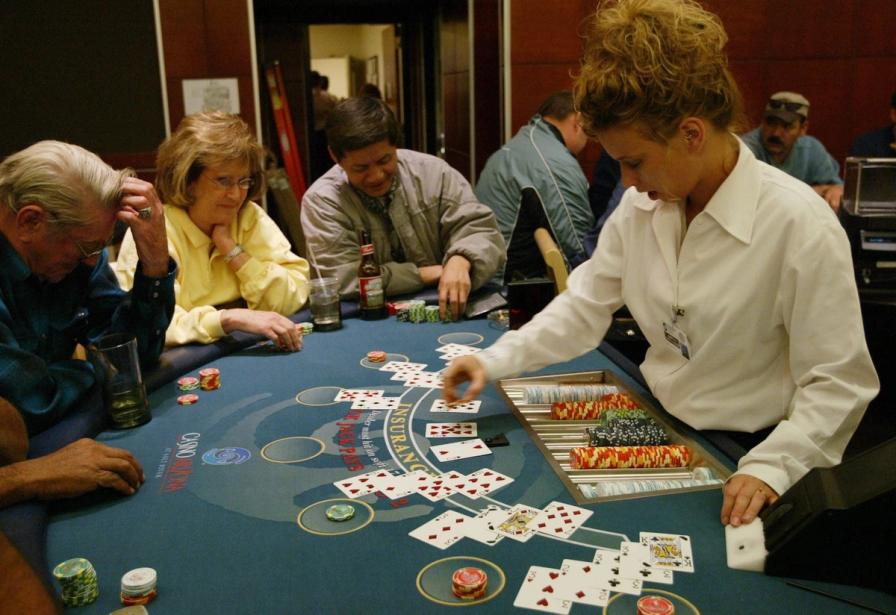
For decades, the two words “card counting” were the shorthand for how to beat the house in gambling. But in 2026, card counting — while still a popular practice — feels awfully ho-hum as gambling schemes go. Keeping track in your head of how many high cards and low cards have come out of the shoe? That’s as antiquated as weekly door-to-door deliveries of milk — especially when, in a span of a few days, the president of the United States’ teleprompter operator is allegedly cashing in on what words the president will say, and an executive for an NFL team is alleged to have fed bettors information on what players that team will draft.
Card counting once sounded seedy, devious. But compared to the modern methods for turning gambling from a minus-EV game to a plus-EV game, sitting at a blackjack table and keeping count as inconspicuously as you can for as long as you can feels downright quaint.
“Oh yeah, card counting, that’s salt-of-the-earth stuff,” said Anthony Curtis, a professional advantage player from the late ’70s until the mid-’90s — when he was forced to stop because there wasn’t a casino left that would let him sit at a table. “An important distinction is that it's not illegal. It's a competition. The casinos have the right to throw you out, but it's a straight-up competition between the card counter and the casino. But nobody's getting hurt. It's a competition where it's not materially affecting anybody except bankrolls on either side — as opposed to what we're talking about now, where people could potentially be getting hurt over these things.”
Curtis means that in a couple of senses. In a prediction market, or any sort of exchange wagering, people can get hurt financially by betting against people with access to more information. But he also means “hurt” in a more depraved and dangerous sense, in a world in which there are markets available on forest fires — which could incentivize the setting of said fires — and in which there are even markets on assassination.
“You’re going to sell contracts on that?” Curtis said in disbelief. “And, I mean, ‘contracts’ is the right word, right?”
Legality, accessibility
Curtis has his eyes keenly fixed on what advantage-seeking activities are and are not currently legal as well as which ones are legal now but may not be for long.
“Card counting is legal,” he said. “And as of right now, making these prediction market bets is legal. But it’s going to get to the point where it’s going to be the same as insider trading, and it’s going to be illegal. It’s just too dangerous.
“And the thing about card counting is it’s accessible to everybody. Anyone can pick up the right book or get the right trainer. If you learn the right way, anyone can do it. Not everyone can get the inside information on the things we've been hearing about. So that’s a very big difference.”
Casino Reports also reached out to longtime advantage player and Unabated co-founder Captain Jack Andrews for his insights on this topic, but we began by double-checking that indeed he’d once been a card counter.
“Asking an AP if they've ever been a card counter is like asking Timothy Leary if he ever tried weed,” Andrews cracked.
“It's the gateway drug,” he continued. “Everybody has tried it. It's effective and also not terribly exhilarating. Here's the thing: I don't know many people who stay card counters. They evolve into hole carding, shuffle tracking, card steering, manipulating casino comps, etc. — all things that the casino industry has at times claimed were illegal. The analogy to what we've seen lately with insider trading is that some things are non-public material information, and other things are just using your brain more than others.
“If you see the dealer's hole card, that is the result of the dealer not protecting the game. Courts have ruled it not to be illegal. Some of these prediction markets need to protect their game better. A casino that deals a single-deck, stand-on-soft-17 blackjack game dealt to the bottom wouldn't scratch their head and say ‘How does this keep happening?’ They realize offering an easily beatable game only leads to more people trying to beat it.”
On the “gateway drug” point, Curtis agreed, saying card counting is “a distant fourth or fifth in terms of things you can do to get an edge on casinos.” And he proceeded to break down how almost every casino game can be beatable.
There are blackjack, poker, sports betting, race betting, and video poker, all of which Curtis says can be beaten when played “on the square.” Blackjack, specifically, is a game of dependent trials — the cards that have come out of the shoe provide information about what remains in the shoe — whereas craps, roulette, baccarat, and others are games of independent trials that essentially have no memory. But those games can be beatable as well, if there are imperfections in a wheel, or a deck of a cards, or a dealer’s technique.
Keep on counting
So, no, card counting at the blackjack table is far from the only way to beat the casinos, and, no, it is not most APs’ favorite way to beat the casinos. But it remains the technique the public most closely associates with beating casinos because it’s simple enough to understand that movies like Rain Man and 21 could take it mainstream and trust that audiences would keep up.
Curtis says card counting is still extremely popular, but the approach has evolved.
“Our biggest-selling book for the past three years has been The 21st Century Card Counter by Colin Jones,” said Curtis, who runs publishing house Huntington Press, “and that's about the new way to play.”
In Curtis’ card-counting days and the days glorified in the book Bringing Down the House (which became the movie 21), you had to be careful not to get busted in Nevada, because if you did, you had almost nowhere else in the U.S. to go.
“Now, the opportunities are everywhere,” Curtis said. “And really what it boils down to is, instead of going for longevity, they just go for the throats. They go in there, they get the money, they get barred, who cares? There’s a million other places to play.”
Everything evolves. Sports bettor Billy Walters used to manipulate markets with “head fakes.” Now public officials are suspected of manipulating markets by intentionally saying certain words with cameras rolling. A couple of decades ago, Eddie Tipton had access to lottery software and cashed in. More recently, enterprising outsiders took advantage of a Lotto Texas jackpot reaching a value that made it advisable to buy up every possible combination.
Maybe it’s just coincidence that the words “scam” and “scheme” sound so similar, but there isn’t always much distinguishing them.
As we go further down the path of pushing edges in the digital betting age — all the way to the current administration brazenly planning to charge six figures per month for information you can trade on — laws may soon be coming that will separate clever schemes from illegal scams.
In the meantime, counting actual physical cards while sitting at an actual physical table is feeling more and more like a relic from the distant past. It requires patience and discipline. And in the instantaneous information age, those are awfully outdated attributes.

Eric has been a professional editor and writer for more than 25 years, including nearly 20 years of experience covering the gambling industry. He was editor-in-chief of the poker magazine All In from 2005-2015 and manag…