Online Casinos Should Quit While They’re Ahead
A Pennsylvania proposal to cap bets and playing time offers a preview of what happens when lawmakers start paying attention


While legislators at both the state and federal level have spent the last few years falling over each other in an effort to curtail, limit, or otherwise futz around with legalized sports betting and prediction markets — not to mention all the hoo-ha over sweepstakes sites — one corner of the gambling world has gone virtually unnoticed.
Online casino play, which is legal in eight states (and live in seven, still waiting on Maine), has gone relatively unchecked. Lawmakers have more or less ignored it, despite tons of studies finding that the dangers of it — real or perceived — dwarf the dangers of betting on sports.
I’ve long held that online casino operators will continue to get a free pass until such time that New York legalizes online casinos. Once that happens, the same mainstream media outlets that have torn into sports betting will find a new bone to chew, and with it will come the regulatory pitchforks and legislative torches.
So one might think that the U.S. operators would be a little proactive on the responsible gambling side and introduce some common sense (already in use in much of Europe, stand by on that) consumer protections in an effort to show, at minimum, good faith.
Or they can do what they’ve been doing thus far, which pretty much amounts to … let ‘er rip!
Lawmakers, enter
Contrary to the lack of such activity up to now, a pair of Pennsylvania lawmakers are seeking to reel in — pun intended — the iCasino operators with a bill that dropped last week.
Pennsylvania House Bill 2879, the Pennsylvania Online Consumer Act, is a bipartisan bill introduced by state Reps. Tarik Khan, D-Philadelphia, and Jamie Flick, R-Lycoming/Union.
Now before we go further, know this: The Pennsylvania legislative session ends Nov. 30, and bills die with the end of the session. If it doesn’t get through this session — chances are likely slim to none, for those looking to place a wager — it would have to be reintroduced next year.
Nonetheless, the bill seeks to put severe limits on online casino play. lt would cap online casino bets at $2 for players ages 21–25 and $5 for those older than 25. It would also require games to last at least 15 seconds and would ban autoplay, limit account time to two hours daily, and impose loss limits and deposit restrictions.
These are some serious changes.
For instance, the 15-second rule would (obviously) limit players to no more than four spins per minute. I’ve gotten some games up to 95 spins in the same time frame.
And the limits on wagering? Well, over on DraftKings (in New Jersey) I can get $60,000 down on a game of Bubble Craps. Or if that’s too rich, you can go to Caesars and play Red Hot Tamales at $810 a spin.

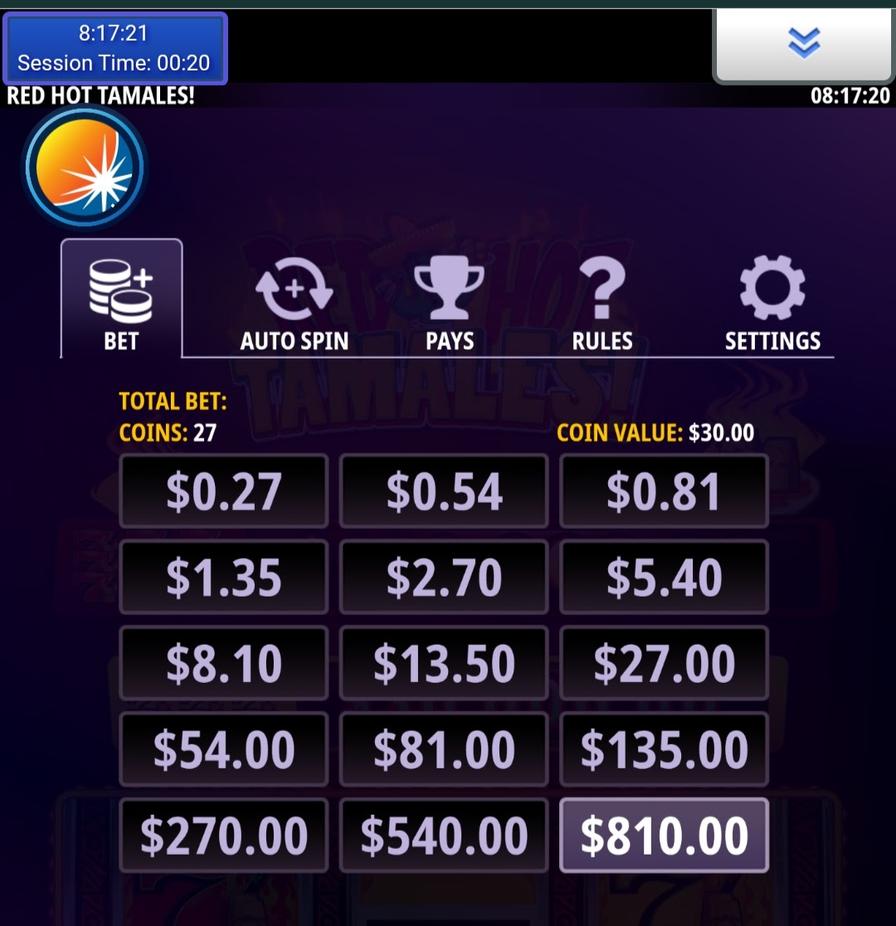
Seriously: What’s going to happen when ProPublica or The New York Times or CBS Mornings finds out about this?
Overseas
I mentioned those European limits earlier. Here’s a sampling: Norway has some of the tightest limits, with state operator Norsk Tipping capping losses across its casino and related instant games at NOK 2,000 ($215) daily and $537 monthly, with lower monthly ceilings for players under 22. It also requires a 15-minute break after an hour of casino play.
Finland’s Veikkaus caps losses on fast-paced games at €500 ($558) daily and $2,230 monthly. Germany generally limits deposits to €1,000 ($1,115) monthly across all licensed providers, though you can ask for an exception. Its online slots have a $1.12 max bet (though they can be raised, slowly and in steps), a pause of five seconds between games, and a five-minute mandatory break after an hour.
Great Britain now limits online slot stakes to £5 ($6.66) for players 25 and older and $2.67 for those 18-24. It also requires at least 2.5 seconds between slot cycles and five seconds for other covered casino games, while prohibiting autoplay. Net deposits above £150 ($200) over 30 days trigger financial-vulnerability checks.
Not to use Europe as a canary in the coal mine, but its countries have allowed online casino games much longer than is the case in the U.S., and the limits above did not come complete. They were added over time.
Would it be so terribly shocking to see legislators impose the same types of limits here? Asked and answered with the Pennsylvania bill. Even if it doesn’t become law — longshot today — I have a hard time believing that online casino play will continue to be the free-for-all it is currently in the legal states.
And frankly, if I ran an online casino, I’d be looking at this legislative proposal and wondering what I could offer up before the next version gets written in the next state and before the editors of the NYT read this.
Do I think adults should be booted off a casino app after two hours? No. Do I think there’s room to slow down a game that allows someone to bet 95 times in a minute? Yes. Somewhere in there is a perfectly reasonable conversation the industry should be willing to have.
Operators could, and should, start it. Pick a limit. Explain why it makes sense. Give up something that actually costs a few dollars in revenue in an effort to grow the industry.
Because waiting until you’re sitting in front of a legislative committee, trying to explain why $810 slot spins are a perfectly fine thing to offer on someone’s phone, seems like a lousy business decision.
I’d much rather explain why I stopped offering them.

Jeff Edelstein is a longtime columnist, reporter, radio host, and fantasy sports aficionado, not necessarily in that order. He lives in New Jersey with his family.