WSOP Contender Gagliano: ‘There’s More Pressure’ On Chip Leader Jumalon
Four-time bracelet winner breaks down competitive dynamic ahead of his shot next week at $10 million

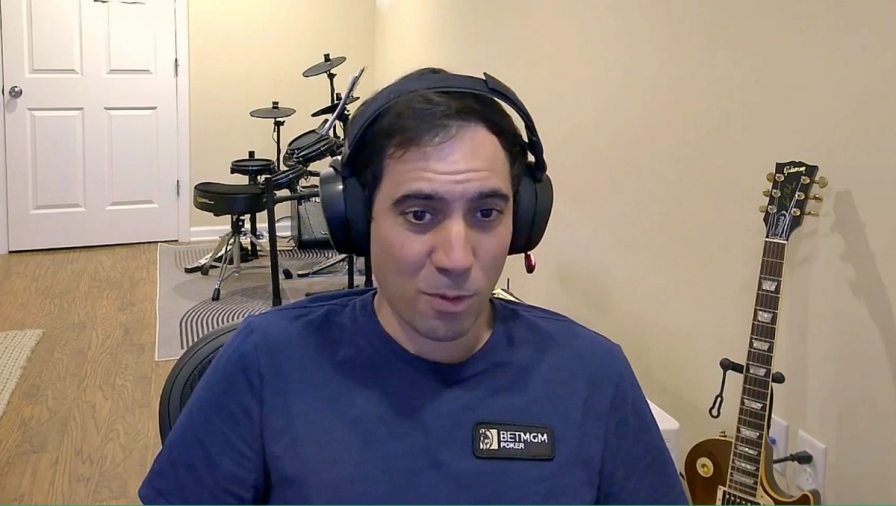
According to the latest Polymarket odds, there’s a 12% chance that Michael “Gags” Gagliano, a 41-year-old poker pro from New Jersey with four bracelets (one live, three online) on his resume, will win the World Series of Poker Main Event next week. With nine players remaining, 12% sounds fairly standard, as in a vacuum, with players of equal skill and equal chips, everyone would have an 11.1% chance.
But the players aren’t all of equal skill, and the chip stacks are very much not of equal size. And the latter fact is the reason 22-year-old Lucas Jumalon is trading at 35% on Polymarket. Jumalon holds 194 million of the 553 million chips in play — 35.1% of them.
It’s a compelling dynamic: There will be eight players with between 15 and 55 big blinds when play resumes in Las Vegas on Monday night (with ESPN2 streaming all the action on delay), and one player with almost 130 bigs. What Jumalon will do with all those chips, and what everyone will do to either take possession of some of those chips or to carefully climb the pay ladder, remains to be seen.
Gagliano, who enters the final table fifth in chips with 46.5 million, discussed next week’s final table and more on the latest episode of the Low Rollers podcast. Here are some highlights of what he had to say:
On battling against the big stack
“Whenever somebody comes in with a lot of chips, I think there’s just more pressure on him. You know, every article that you read is, ‘He's gonna close it out. Can he do it? Can he go the distance?’ And yeah, he's got a lot of the chips, he does just win this tournament a fair clip of the time. But it's not like he has infinite chips. I mean, he doubles up anybody, and everyone's all of a sudden within punching distance of him.
“Lucas has played well. I haven't played with him a crazy amount, but he's put the pressure on in spots where he could, and I expect him to probably do the same here. But final tables are weird, right? If you're the chip leader and you start raising and everybody just keeps folding, sometimes you can run away with it. But I don't anticipate this group of guys just to completely roll over. I think that there's at least a few guys that are gonna make a stand and try to take a shot at him.”
On how he’s been preparing
“I'm keeping the gears flowing. I wouldn't say I'm doing hardcore preparation or anything. Just trying to keep things fluid. Trying to just relax and just kinda get there fresh.
“I think most people are gonna go back and watch the [livestream] footage just to have an idea of some people's strategies and kind of get a feel for their game. But I don't think you're really gonna find some hidden gem or crazy tell or something that's gonna make you win the tournament. It's just for completeness — understand how people got there and just get a feel for what they're doing in different situations.”
On whether poker players play differently on camera
“I don't think I approach things differently. But I will say that there are a lot of people who do play very differently. So I may do things differently in response to someone else doing something differently. Because as a poker player that's constantly trying to get that edge, I need to respond to how my opponents are playing. And if I notice someone's playing real crazy because they want to impress people on the stream, then I need to adjust. If I notice this guy does not want to make a fool of himself on national television — he's only gonna play really good hands — I'm gonna have to adjust to that.
“I've had a couple different times where the producer comes over before dinner break and says, ‘Hey guys, when you get back from dinner, you're gonna be on the feature table on stream.’ And people get really nervous. And I've seen people go get their hair cut and come back with new clothes and look completely different.
“I had one table where it was a really loose and splashy table. Everyone was really enjoying themselves in the main event, chatting a lot, and the pots were kind of crazy — just a lot of splashy play, a lot of chips flying around. And they told us we were going on the feature, and we came back to the feature and everybody clammed up. The guys who were playing 60-70% of hands just played nothing. It was a very different vibe.
“The group of guys next week, I don't think there's gonna be someone trying to do something crazy the first hand just to show off. It's a bit of higher stakes and everyone seems to have their wits about them. So I don't think there's gonna be anything crazy out of the ordinary like that. But, you know, I'll look for it. If somebody shows up and the pressure's getting to them and they're looking to torch it off, maybe we'll have to tangle a bit.”
On how quickly anyone’s run can end
“It's a poker tournament. … Everyone's gonna play a little different because it's the Main, but at the end of the day, if I get kings and someone else gets aces, I'm probably just gonna be out. Like, what can you do? It's funny, I've been telling people, friends and family from home are like, ‘I wanna come watch you.’ And I'm like, ‘Alright, that'd be great. I would love the support, it's gonna be a lot of fun. But just so you know, it's poker. Like, this is not a soccer game, it isn't the World Cup, or a football game, where like you're gonna get 60 minutes of cheering me on. Like, I might play two hands and be out and then we have like three days to sit in Vegas.’”
On comparing the poker disciplines
“People want to talk a lot about tournaments versus cash games and who's better. I use the example of a runner — one being a distance runner and one being a sprinter. Like, you wouldn't compare those and say who's the better runner? Obviously they're both tremendous runners, just in different disciplines. And poker's the same way.”
On choosing poker over a more traditional career
“I would say I was not a pro until I quit my job in 2009. I was working at an elementary school. I was a staff assistant. … After I graduated — or kind of graduated college, I like barely, barely graduated — there was an opening in the fall [of 2007] … so I was like, all right, I have nothing else to do.
“Towards the end of college, I started making some money [playing online poker], but we're talking, like, a couple thousand dollars. And then 2007, 2008, I started making more money. And you gotta keep in mind, this is 2008, 2009, the financial crisis. Like, nobody was able to get jobs. All of my friends were struggling. Anybody who did get a job, it was paying $30,000, $35,000 a year. It was not a lot of money. And so if I was able to make a little bit off my job and then $15,000, $20,000 a year playing poker, that was like — I had so much money, that felt, like, infinite. And the school job did not pay well.
“And it got to the point where I was playing so much poker after school, I would race to get home because I could register tournaments that started like 3, 3:30. And I was staying up so late in these tournaments that I was so tired. I was coming in [to work] late a lot. But I was making so much money playing poker that I stopped picking up my paychecks, because, like, the paychecks were like $500 for like two or three weeks’ worth of work, and it was like, I made way more than this playing poker.
“So finally, in 2009, I got more serious. I was like, I'm gonna give this a shot. I'm gonna go to Vegas, see what happens. And, you know, the rest is history.”

Eric has been a professional editor and writer for more than 25 years, including nearly 20 years of experience covering the gambling industry. He was editor-in-chief of the poker magazine All In from 2005-2015 and manag…