DC Council Committee Votes To Mark Up Online Casino Bill, Inching Closer To Legalization
Passage on 3-1 vote sets up potential for final approval in December

Six months passed without any action on the District of Columbia’s bill to legalize online casinos following a May hearing in the DC Council’s Committee on Human Services, but the council finally continued the discussion Wednesday afternoon — and picked up right where it left off.
The Committee on Human Services further considered B26-0656, the Internet Gaming and Consumer Protection Act of 2026, and voted 3-1 at the end of the meeting to advance the bill to a full DC Council vote, most likely in December.
Committee Chair Matt Frumin, Councilmember Wendell Felder (who introduced B26-0656), and Councilmember Zachary Parker all voted in favor of the bill, while Councilmember Christina Henderson cast the lone dissenting vote after laying out her reasons for opposition.
The legislation is different from what’s been seen in most states in that it not only seeks to regulate and tax commercial online casino play, but it aims to do so with sweepstakes-style gaming as well. Other key features of the bill include a minimum customer age of 21, a 25% state tax on adjusted gross internet gaming revenue, and a $2 million licensing fee for every operator.
The activity would be regulated by the Office of Lottery and Gaming, and there was much discussion at Wednesday’s meeting of an increase in money earmarked for problem gambling funding, from $500,000 in the original version of the bill to $750,000.
Heading into the meeting, the UNITE HERE Local 25 union endorsed Felder’s bill.
The committee projected $73 million in tax revenue from iGaming over the first four years if the legislation passes.
The pro case, the con case
Much of the discussion centered around recognition that Washington, D.C. residents are already playing online casino games for real money using unregulated operators, so, as Frumin said, “This legislation sends a clear message the district is no longer going to leave itself powerless against rogue operators.”
Added Felder: “Online casino gaming is already available to district residents through unlicensed platforms without safeguards and protections. … At the same time, the district is missing out on potential revenue. Simply ignoring the issue does not make it go away. The goal of this legislation is not to encourage gambling, but to add a responsible framework and consumer protections.”
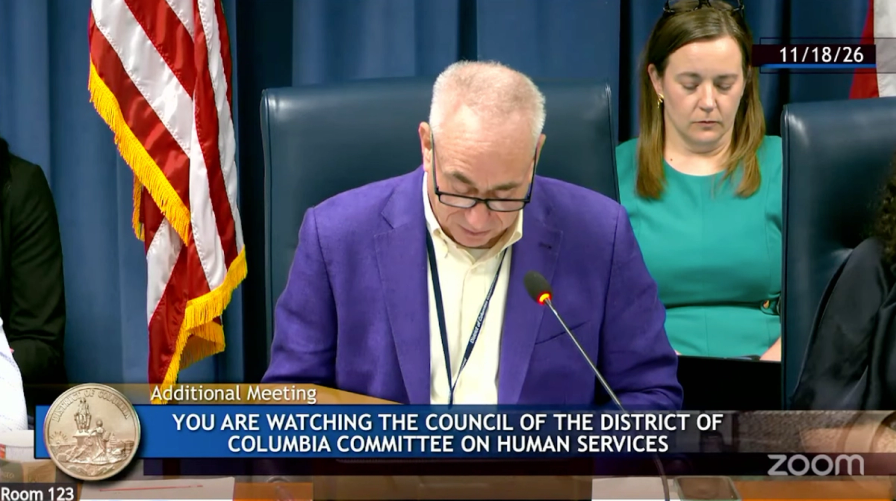
Felder continued, anticipating opposition speech from Henderson, “I recognize iGaming comes with legitimate concerns, and those concerns should not be dismissed. In fact, they are exactly what this bill seeks to address.”
Henderson did indeed spell out her concerns about legalizing online casino gaming, beginning by citing problem gambling statistics and bankruptcy risks in states that regulate the activity. “I don’t think that we can build our revenue on the backs of people’s addictions,” she said, expressing worry about expanded online gambling exacerbating mental health crises.
She also made clear she was not satisfied with the problem gambling funding increase. “While I appreciate that we’ve upped the number to $750,000,” Henderson said, “$750,000 for the entire district is about a dollar a resident. That is not enough.”
Before a vote could be taken, Henderson bluntly stated, “I’m not supporting the bill today. But if it moves forward, I’d like to address some of the consumer protection issues in hopes of mitigating some of the negative consequences.”
Frumin, saying he intends to address those concerns before the bill receives its first reading in front of the full council, was respectful of Henderson’s opposing stance. “There are going to be differences of opinion,” he said, “and you absolutely should vote no today.”
At the end of a 30-minute discussion, Henderson proceeded to vote no, but that wasn’t enough to prevent the legislation from taking a step forward. The deadline for the bill to pass the full council is Dec. 15.
Is Candy Crush a sweepstakes game?
There were also moments during the meeting that veered down side paths and revealed the extent to which some councilmembers will require further education on the issues at hand.
Most notable among these was Parker, who said “I generally am supportive” of the legislation while asking about games like Candy Crush and expressing concern that such “social games” will be regulated and taxed in a way that harms the companies offering them. The term “Social Plus” for sweepstakes-style gaming appeared to be the source of the confusion, but Frumin clarified, with help from a younger staffer, that Candy Crush is not part of the dual-currency gaming that would be captured under the bill.
“So grandma’s Candy Crush is OK, it won’t be bothered,” Parker processed aloud, satisfied with the clarification.
Frumin also brought up the fact that he’d recently received a promotional mailer from prediction market Kalshi, furthering his concern about gambling operations that are not locally regulated but reaching citizens of D.C. The chairman of the committee is clearly motivated to separate the white market from the gray and black markets in the nation’s capital.
The year 2026 began with Maine unexpectedly legalizing online casino in January. There now appears to be realistic potential for D.C. to bookend the year by doing the same in December.

Eric has been a professional editor and writer for more than 25 years, including nearly 20 years of experience covering the gambling industry. He was editor-in-chief of the poker magazine All In from 2005-2015 and manag…