Playing Online Casino Is Easy, Passing Online Casino Legislation Is Not
Legislators actively pushing for iGaming legalization in Massachusetts, Ohio, and Virginia discuss aims, hopes, and challenges


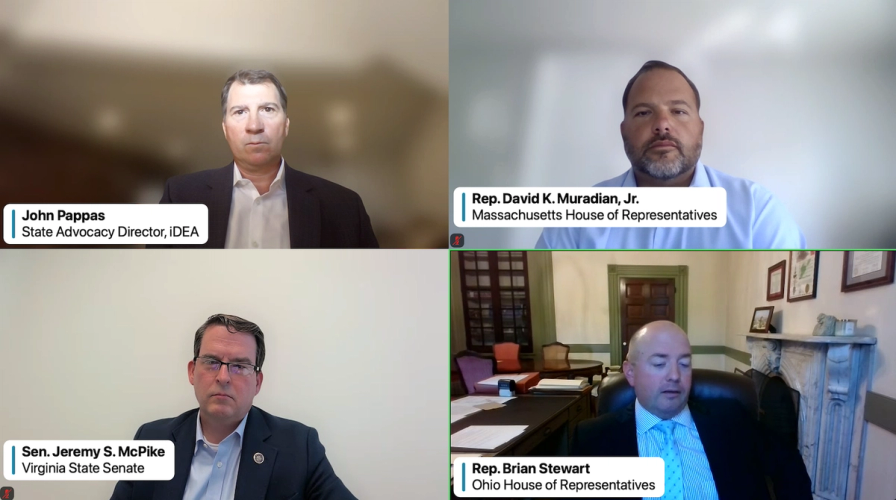
Rep. Brian Stewart introduced online casino bills in Ohio in 2025, so he has direct, first-hand experience with the struggles attached to trying to legalize and regulate iGaming at the state level. On a webinar Friday hosted by iGaming advocacy group iDEA Growth, Stewart got into specifics of what he’s come across.
“Legislators my age and below, I get no pushback on online gambling legislation. Legislators my age and above? It’s a much harder sell,” Stewart, who was born in 1982, explained to moderator John Pappas. “There is still the general unease with technological advancement.”
Stewart went on to detail that “the most compelling opposition testimony” he heard was from a fellow legislator who contrasted the effort required to get dressed, get in a vehicle, and take a trip to a brick-and-mortar casino with the complete lack of effort required to play casino games on one’s phone or computer. “That is an argument that I see gaining traction in my caucus,” the Republican representative said. “If we’re going to get this done in Ohio, we’re going to have to have an answer for that.”
Worry about ease of access is just one of the many issues gaming-friendly legislators have encountered. And those many issues have added up, thus far, to only eight states in the last 15 years passing bills to legalize online casino gaming.
Those issues, and the possible solutions and talking points, were covered in great depth during what iDEA Growth called the “2026 Power Lunch Summit,” where Ohio’s Stewart was joined by Massachusetts Rep. David Muradian — like Stewart, a Republican — and Virginia state Sen. Jeremy McPike, a Democrat. All three have introduced legislation in their respective states, and all three have been unsuccessful to this point in advancing that legislation. But they all intend to keep trying.
“Policy takes time,” Muradian insisted, noting Massachusetts has a two-year legislative cycle in which often a bill passes in one branch and stalls out in the other. “The legislative process is deliberate in its difficulty to pass legislation at times. And truthfully, it probably should be. Sometimes it just takes time.”
“We have in Virginia a quasi-gambling product through our state lottery system,” McPike added, “and there are online platforms overseas, consumers are seeking out online gambling through various forms. How do we have some taxation around it, and how do you provide problem gaming support? How do you provide a consumer protection framework and regulatory framework that makes sense? There are lots more of those discussions to come … and [you need to] have creative solutions for people who provide pushback.”
The tax revenue is undeniable
One argument that’s easy to make is that online casino generates money for the states that regulate it. Pappas noted to kick off the discussion that regulated iGaming produced $2.6 billion in state taxes in 2025 and is on track to exceed $3 billion in 2026.
“I think a lot of people are open to the idea of iGaming primarily from a revenue standpoint,” said Stewart, whose state is bordered by three legal iGaming states in Michigan, Pennsylvania, and West Virginia. He noted Ohio will have a new governor next year when Mike DeWine’s term ends, and with that could come new hope: “You actually had one of the candidates for governor — and it wasn’t the one I expected — say she was open to iGaming revenue.”
That reference is to Democrat Amy Acton, a 58% favorite at Kalshi as of Friday to defeat Vivek Ramaswamy in November.
Stewart and Muradian both singled themselves out as not just pro-gaming legislators but active recreational gamblers as well who previously helped their states pass online sports betting legislation.
“For me it comes down the simple premise of Massachusetts residents are already participating in online gaming, and it isn’t a question of whether we should allow it, but how we should regulate it,” said Muradian, whose state just launched iLottery in July. “People have access now, it’s unregulated, it’s the wild west, it’s offshore. For legislators, we have an obligation to establish the rules of the road for an activity that is occurring … It’s the safeguards for me. If people are doing it, we should put safeguards in place.”
McPike echoed, “The market’s out there. They’ll find a way to access iGaming online somewhere. Our struggle in Virginia is the maturity of our gaming framework. We’ve been working for a couple of years to mature our gaming commission level. [The question is] do you have the infrastructure and staffing to stand up a new model, to stand up a market appropriately and responsibly?”
He also expressed that promulgating rules and approaches does not take place in a vacuum.
“We can learn a lot from the other states [that already regulate iGaming],” McPike said. “You have two ears and one mouth. When you listen more, you create a collaborative process. You don’t write a bill in isolation. Throughout the process, you have public feedback. You watch a bill evolve, and you end up with a bill with purpose.”
McPike also pointed out that the surrounding environment evolves, using as an example the fact that skyrocketing gas prices are reducing discretionary spending for some Virginians, meaning he’ll have to recalculate his forecasts for iGaming tax revenue before he begins his next push for legalization.
Is online a friend of land-based?
Invariably in discussions like these, the issue of whether online casino cannibalizes brick-and-mortar casino play comes up, and this was no exception. Pappas pointed out that New Jersey is on pace for its highest land-based casino revenue total ever this year amid a fairly mature but still growing regulated online market. “This is a state where the land-based and the online industry are growing together,” he said.
But not everyone sees it that way, and in Ohio, Stewart made a point to address land-based casinos’ concerns in his previous iGaming legislation.
“There was a real concern over the promotional credits,” he said, noting that when sports betting was legalized, national behemoths like FanDuel and DraftKings came in and used attractive promotions to win over customers and perhaps limit their visitation to land-based sportsbooks. So for online casino, he included a stipulation that online promo credits would not be an option. Rather, the online sites had to partner with brick-and-mortar casinos and could only offer land-based credits, so the sites would be “directing people to the terrestrial casinos and racinos.”
Stewart made one additional key observation based on his experience trying to advance legislation: A great deal of education is still required for most lawmakers, and that’s another part of why things continue to move slowly.
“Because people in the industry live it every day, they assume other people are somewhat aware. And that’s just not the case,” Stewart said. “I think there are a lot of things that these apps do, in terms of how they work, facial recognition, what they do from a responsible gaming standpoint, that legislators are not aware of.”
So the education continues. And the effort continues. So that someday soon, citizens living in these states will be able to participate in regulated gambling without much effort required themselves.

Eric has been a professional editor and writer for more than 25 years, including nearly 20 years of experience covering the gambling industry. He was editor-in-chief of the poker magazine All In from 2005-2015 and manag…