Ruddock Report: For Online Casino Expansion, It’s A Case Of Wait ‘Til Next Year
Nothing more will change in 2026, but several states are in play for 2027


Our monthly look at the online gambling landscape includes the current legal and regulatory scene, prospective online casino and online poker states, and significant trends to watch.
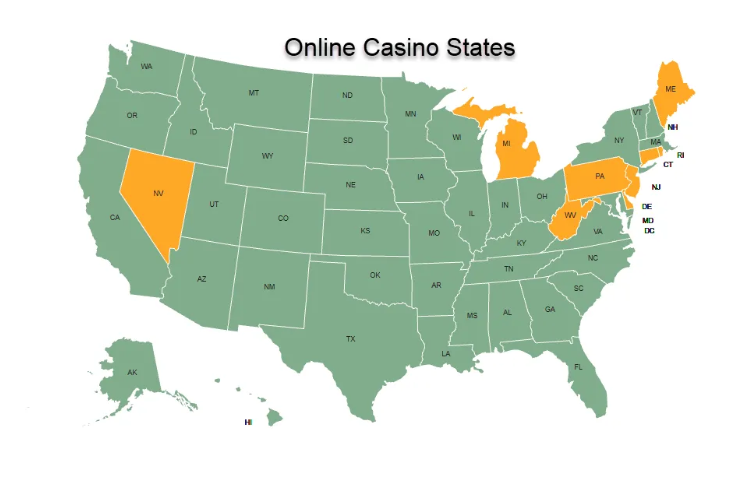
The legislative calendar is winding down across the country, and while there are still a few glimmers of hope in legislatures that go year-round, it’s safe to say the legal online casino map isn’t going to undergo any more changes in 2026.
But have no fear, online casino supporters have gotten very good at saying, “There’s always next year.” And optimism for movement in 2027 is already out in full force.
Caesars Digital head: Prediction markets a catalyst
As reported by CDC Gaming, while speaking to the Nevada Society of Certified Public Accountants (where all major online gambling news is broken), Eric Hession, president of Caesars Digital, called prediction markets the nudge that could get some states to consider legalizing online casinos: “As states start to see their revenue move to untaxed prediction markets, there will be pressure to legalize and tax it or allow casinos if they already have legalized sports betting.”
The same sentiments have been bandied about for several years, with gaming executives pointing to sports betting opening the door to online casinos as states become more comfortable with online betting, the existence of sweepstakes and now prediction markets (it’s already happening!), and even states scrambling to fill budget holes as federal COVID funds dry up.
These are all excellent, logical reasons for legalization, but they don’t consider one very important detail: The idea of legalizing online casinos is extremely unappealing to many people, and I’m not just talking about the opposition like anti-online land-based operators, labor unions, and social conservatives.
There are a few cohorts that want online casino games legalized:
- Companies that will benefit financially from legalization
- Online gamblers unhappy with current offshore and sweepstakes options
- Online gamblers who will only bet on regulated sites
These are very small cohorts, although the first one has a very loud voice. Most people either don’t want it legalized or don’t care about the issue.
As I’ve noted about the debate over the 90% gambling loss deduction cap, whenever it comes up in non-gambling circles, most comments fall somewhere in between “Who cares?” and “It should be 0%!”
Looking ahead to 2027
There will be several states to keep an eye on in 2027, including these four:
New York: New York is a perennial contender. While there has been little in the way of real momentum for past efforts, now that the state’s downstate casino licenses have been awarded and Resorts World has added table games, New York might be ready to tackle its next gambling expansion. Challenges include union opposition and a governor who doesn’t seem very interested in the topic.
Illinois: This is another state that seems to consider online casino legalization every year, but like in New York, these efforts have gone virtually nowhere. On the plus side, the state is running out of ways to pump existing gambling for revenue, having raised taxes on sports betting in 2024 and 2025 and having authorized VGTs in Chicago. Working against legalization is the politically powerful VGT industry and land-based operators that oppose online expansion. If the VGT industry comes on board, Illinois would be one of the strongest candidates. If it doesn’t, I’ll be writing this same entry next year.
Maryland and Virginia: The mid-Atlantic states appear to be the top candidates, particularly with progress this year in Virginia, where the House and Senate passed online casino bills but a compromise couldn’t be reached in conference committee. I’ve lumped the two states together, as success in one is likely to spur action in the other. That said, both states face similar obstacles, with strong in-state opposition from casino interests.
2025-2026 online casino bills
The Ruddock Report will revise this list as new bills are introduced.
Active bills
Illinois
- HB 4797, sponsored by Rep. Edgar González, Jr.
- HB 4802 (poker-only), sponsored by Rep. Edgar González, Jr.
I’ve likened Illinois to the little engine that can’t, as there have been efforts to legalize online casinos in the state going back more than a decade.
There is certainly high-level support, as Gov. JB Pritzker called iCasinos an idea worth exploring last year. Pritzker’s 2026 budget says nothing about online gambling but does propose increasing taxes on existing casino table games.
More importantly, until the politically powerful VGT industry is on board, which is unlikely to happen anytime soon, legalization will remain out of reach. In January 2026, the team at Citizens met with Accel Entertainment and was told by Accel management that “there is no shot” of iGaming legalization in the state.
And recall that a March 13, 2025, hearing turned into an anti-legalization struggle session, when the anti-online crowd marched in small business owners to hammer home its point.
Rep. Edgar González Jr. has filed two bills in 2026. The first resembles last year’s effort, HB 3080, while the second is an online poker-only bill that has no text and simply reads, “Amends the Illinois Gambling Act. Adds a Section concerning online poker. Contains a Section heading only.”
Also working against Illinois is the ongoing effort to repeal the recently enacted city of Chicago tax on sports betting, and the authorization of VGTs in Chicago.
New York
New York has frustrated online gambling supporters for more than a decade. Last year’s efforts barely got off the ground, as the state was busy handing out downstate casino licenses. Now that those licenses have been awarded, there is growing optimism that the legislature can turn its attention to online expansion, but there are still several hurdles to clear.
Opposition comes from the state’s labor unions and cannibalization concerns. With one new casino here and two more coming, that means thousands of new union jobs to voice concerns about online cannibalization. Nor are the three casino operators (Bally’s, Hard Rock, and Genting) online-focused companies.
And New York Gov. Kathy Hochul hasn’t shown any signs of supporting iCasinos.
Washington, DC
- CB 260656, sponsored by Councilmember Wendell Felder
A new bill in Washington, D.C. would legalize online casino games while simultaneously prohibiting sweepstakes sites. The bill would impose a licensing fee of $2 million and set the tax rate at 25%, with an additional 2% local fee.
A hearing was held on May 4, but after four hours of robust debate, no vote was taken.
Inactive bills
Hawaii
The bills did not meet the legislative deadline and are effectively dead for the year.
Maryland
State Sen. Ron Watson introduced two separate bills, one to legalize online poker and one that would legalize online casino games and bingo. SB 885 is paired with SB 761, which requires a statewide voter referendum in November 2026 for full implementation. The online poker bill sought to overcome the union and stakeholder opposition that has thwarted the state’s past online casino efforts.
A hearing on March 11 in the Budget and Taxation Committee resulted in no vote, as problem gambling and cannibalization concerns persist.
The bill failed to pass the Senate before the March 23 crossover deadline, rendering it effectively dead for the year.
SB 884 was withdrawn by Watson on March 13.
Massachusetts
- HB 4431, sponsored by Rep. David Muradian
Massachusetts held two committee hearings on online casinos in 2025, but a vote was never taken. A June 23, 2025, legislative hearing (on HB 332 and SB 235) was short and sweet, with testimony and no questions from the committee. No vote was taken at the November hearing in front of the Joint Committee on Economic Development and Emerging Technologies either, but lawmakers did ask questions, and most of the questions pointed to concerns about existing harm from sports betting.
The bill was sent to study on March 23, effectively killing it for the remainder of the year.
The upcoming launch of online lottery products will also make further expansion difficult, as state Treasurer Deborah Goldberg said in December: “I, right now, am firmly against iGaming. They may not like me for that, but I gotta think about the people of Massachusetts, and that’s my top priority.”
Virginia
Virginia burst into the online casino conversation last year with two bills: SB 827, sponsored by state Sen. Mamie Locke, and HB 2171, sponsored by Del. Marcus Simon. The existence of the bills wasn’t a surprise, but the attention they received certainly was. Still, stakeholder opposition and union concerns caused Locke and Simon to pull their respective bills.
Simon and Locke introduced new bills in January 2026, HB 161 and SB 118. The new bills include policies to address lottery and job concerns, as well as higher problem gambling funding.
The bills progressed to a conference committee, where they failed to receive approval.

Steve is a highly respected and oft-cited voice in the legal online gambling space. Steve is an analyst and consultant and the publisher of the Straight to the Point newsletter.