Youthful State Senator Strives To Protect Online Gamblers — And The Industry
Pennsylvania’s Joe Picozzi, 31, has witnessed problem gambling among his peers and believes the apps need more guardrails

You might not know it from the steady wave of stories about lawsuits related to gambling operators’ VIP departments encouraging addicted players to lose more money, but problem gambling is not good for the house. At least not if the casino is playing the long game.
And lots of folks running casinos or sportsbooks get that. Joe Picozzi, a state senator in Pennsylvania — a state with 17 brick-and-mortar casinos as well as legal online casino gaming, sports betting, and poker — related to Casino Reports this week a conversation he had with an executive at one of the larger local casinos.
“He said, basically, ‘Joe, our business model is we want people to come in here once, maybe twice a week, lose like $50 to $100, and go home,’” Picozzi said. “‘If people do that, we're in business and we're good. What we don't want is people blowing through their life savings and putting themselves in a really destitute position.’”
Sen. Picozzi’s goals as they pertain to gambling align with those of the casino honcho. He doesn’t want to outlaw gambling. He doesn’t want to be seen as a “nanny.” He just wants more guardrails in place because he’s seen firsthand what can happen when people — young men in particular — are left to their own devices.
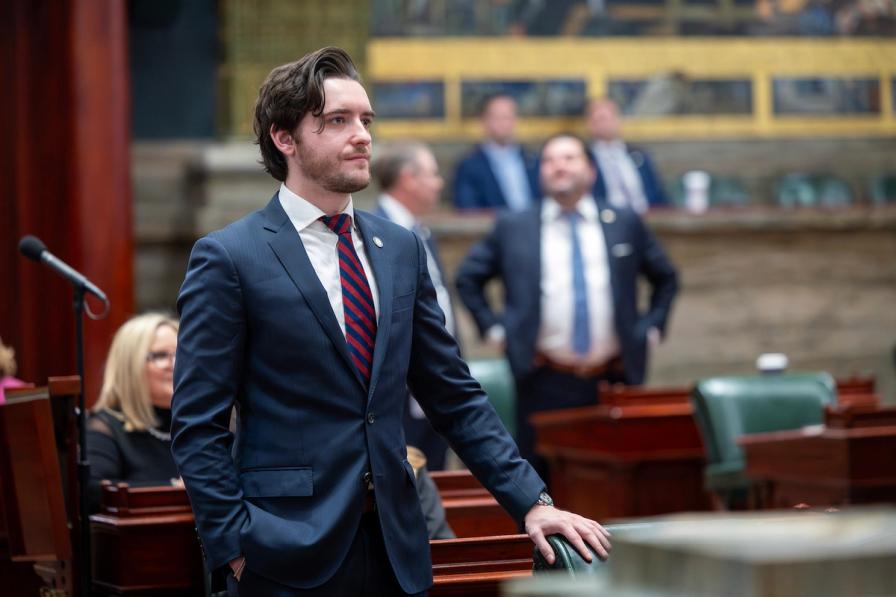
Picozzi, you see, is only 31. He’s an outlier as a Republican elected in the mostly deep-blue Philadelphia County, having won a narrow election in November 2024 when his party exceeded expectations all over the country. And he’s a generational outlier because he’s half the average age of the members of his chamber — which was 60.03 in 2024 (back when Picozzi was a mere 29).
But being 30-ish in a sea of middle-aged legislators gives Picozzi a unique and valuable perspective.
“I got interested in this subject mostly because of friends of mine who, at a pretty young age, got fairly addicted to this stuff,” he said. “Gambling has become so ingrained in American society today, particularly among my generation. I look at how it's affecting people. And it's basically being marketed to us, an economically precarious generation, as, ‘This is your path to financial stability.’ And it’s certainly not.
“And so, I think that it's important the legislature is taking this seriously, is thinking through ideas on how we can best manage this. With online gambling, sports betting, we have to really pick up the pace because this technology is evolving very rapidly, and we need to make sure the government's up to date on protecting consumers.”
A cause becomes a caucus
In October, Picozzi took part in the formation of the Problem Gambling Caucus as co-chair, and he’s hopeful that in 2027, he can advance legislation to further responsible gambling efforts and prevent some of the struggles he’s witnessed among his friends.
“It can be a hobby, it can be a pastime, it can be a fun thing that you do with money that you can afford to lose,” Picozzi said. “But I have friends who can't pay their rent because they just made too many bets. I had buddies during Covid that were betting on all kinds of bizarre foreign contests because they needed to get that gambling fix. That's not what you want. You want people to enjoy making bets. There's absolutely nothing wrong with making a bet here or there. The problem I think we run into is people thinking that their path to financial freedom is a seven-leg parlay.”
Last month, lawmakers in the Pennsylvania House introduced bipartisan legislation to put strict limits on iCasino play. The legislative session ends Nov. 30 and nobody has any expectation of the bill going through, which means it would likely be reintroduced next year. And Picozzi has his mind fixed on something similar in the Senate.
“I'm very hopeful that this issue can draw bipartisan support, and we can move forward with some common sense legislation — but it's just so hard to predict how it will shake out when we're walking into a fundamentally different dynamic in Harrisburg,” Picozzi said. He’s referring to both chambers moving in a blue direction in the midterms, with Democrats in the House going from a narrow majority to a comfortable majority and with the Senate flipping to Democratic control for the first time since 1993. Picozzi notes, though, that the Problem Gambling Caucus was “able to get bipartisan bicameral support, which is a really good sign.”
So what does Picozzi hope to change? For starters, he wants to do something about the deceptive marketing referenced in his comments above, where gambling is presented as a way to get rich.
He also wants online gambling to come with a little more friction.
“If you wanted to go to the casino,” he said, “you've got to get in your car and drive to the casino, and a lot of times you play games with cash, so you feel the money leaving your pocket and you can say ‘I was holding $200 a few minutes ago and now I'm holding $50, maybe I should leave.’ Whereas when you have a casino on your phone or you have sports betting on your phone and you're paying with a credit card or online account, you're removed from reality a little bit. So, I’m just looking for basic things like making sure the apps are really transparent with people about where they stand in terms of wins and losses, so they know not to throw good money after bad. Creating some kind of friction like — ‘hey, take a 15-minute pause before you make another bet,’ that kind of system could be really helpful.”
Some functions along those lines exist at regulated sites — pop-ups that inform a player when they’ve been logged on for 30 minutes, opt-in responsible gambling tools that show user histories. But Picozzi thinks there should be more of it. And he thinks technology should be used to make it better.
“The artificial intelligence that's used to promote these apps knows more about the consumer than the consumer knows about themselves,” he said. “It shouldn't be that hard to use these tools to be able to politely say to somebody, ‘Hey, chill out for 15 minutes and think about this before you put another $1,000 in.’”
The more you know
A fair amount of education will be necessary with some of Picozzi’s older colleagues in the legislature who aren’t as smartphone-savvy as Millennials and Gen Z-ers. While Picozzi is aware of gambling-adjacent elements of Fortnite and Pokemon and has a finger on the pulse of card rips, there are plenty of legislators in both chambers who are just starting to wrap their heads around what a sports betting parlay is.
In other words, getting what Picozzi calls “common sense reforms” passed will be a process.
But in the end he sees this project as every bit as vital to the operators as it to the potentially vulnerable customers.
“When people are in gambling debt, when people like lose their life savings, nobody wins that bet. Even gambling companies lose, because they just lost somebody who could have been a client for 30 years. So, nobody wins in that equation,” Picozzi said. “I think if the caucus is going to be successful, we need to make sure the industry is at the table and having these conversations, and I like to think they'll be willing to talk at least. We are not out to get them. We are just looking out for the consumers. If we do a few common-sense things, it's going to do a lot of good for the whole industry.”

Eric has been a professional editor and writer for more than 25 years, including nearly 20 years of experience covering the gambling industry. He was editor-in-chief of the poker magazine All In from 2005-2015 and manag…